The Shot You Didn’t Plan For
The most celebrated photograph from your expedition will probably not be on your shot list. It will be a moment you stumbled into — a break in the clouds you did not expect, a composition you discovered while walking to a different viewpoint, a human interaction you could not have predicted.
This does not mean planning is worthless. It means the opposite. Planning put you in that place, at that time, with charged batteries and formatted cards. Planning freed your attention from logistics so you could notice the unexpected. The photographer who is lost, hungry, and worried about permits does not notice light.
Galen Rowell, whose mountain photography remains unmatched decades after his death, planned meticulously. He studied topographic maps, calculated sun angles by hand, and researched weather patterns for weeks before expeditions. Then he arrived and responded to whatever the mountains offered. The planning created the conditions for spontaneity.
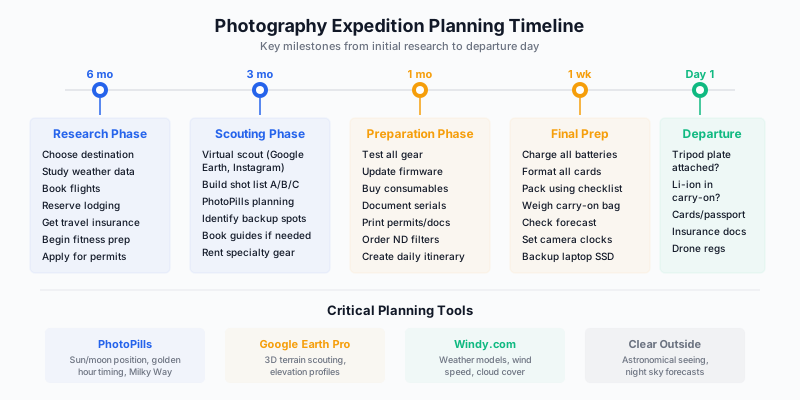
This guide covers the planning process that puts you in position — from choosing a destination six months out to walking out the door on departure day.
Choosing a Destination
Iconic vs. Undiscovered
The first decision shapes everything that follows.
Iconic destinations (Iceland, Patagonia, Norway, New Zealand):
- Guaranteed dramatic landscapes that deliver strong images even in mediocre conditions
- Established tourism infrastructure — roads, lodging, guides, cell service
- Extensively photographed, making unique compositions harder to find
- Higher costs due to tourism demand
- Well-documented locations with abundant reference material
Undiscovered destinations (Faroe Islands, Georgia, Oman, Svalbard, Greenland):
- Unique imagery with high originality potential
- Fewer photographers competing for the same compositions
- Challenging logistics — fewer roads, limited lodging, language barriers
- Harder to research — less reference material exists
- Often more rewarding precisely because of the difficulty
The strategic approach: Alternate between iconic foundation trips (where you build core skills and reliable portfolio images) and exploratory expeditions (where you develop your unique visual identity). Your first trip to Iceland teaches you how to photograph in extreme conditions. Your second trip to the Faroe Islands teaches you how to see for yourself.
Five Criteria for Selection
Before committing money and time, evaluate each destination against these criteria:
| Criterion |
Question to Answer |
How to Research |
| Photographic potential |
Does this place offer what I want to shoot? |
Instagram location tags, 500px, Google Earth |
| Weather probability |
Is there a realistic window for usable conditions? |
Weather Spark, Climate-Data.org |
| Accessibility |
Can I reach key locations with available transport? |
Google Maps, rental car requirements |
| Safety |
Is the region stable and safe for solo or small-group travel? |
Government travel advisories |
| Budget |
Does the total cost fit my resources? |
Lodging, flights, vehicle, food, permits |
Photographic potential is necessary but not sufficient. A destination that scores high on potential but low on accessibility may cost you three days of driving for one hour of shooting. The best expeditions score at least moderately on all five.
The Research Phase
If you plan photography expeditions and do not own PhotoPills, you are leaving image quality on the table. This $12 app provides information that would otherwise require hours of manual calculation.
Core planning features:
- Sun position: Exact azimuth and altitude of the sun at any location, date, and time. Overlay sun path on a map to see where sunrise/sunset light will fall on terrain.
- Golden hour and blue hour: Precise start/end times for the quality light windows that drive landscape photography.
- Moon phase and position: Critical for astrophotography and moonlit landscape planning.
- Milky Way visibility: When and where the galactic core is visible, with azimuth and altitude data.
Planning workflow in PhotoPills:
1. Drop a pin on your planned shooting location
2. Select your travel date
3. View the sun path overlaid on the satellite map
4. Note the exact direction of sunrise and sunset light
5. Identify compositions where the light hits terrain at the optimal angle
6. Save the pin with notes for on-location reference
Google Earth Pro: Virtual Scouting
Google Earth Pro (desktop, free) lets you scout locations in 3D without leaving your desk.
Techniques:
- Enable the terrain layer and tilt the view to see topography
- Navigate to potential viewpoints and rotate to preview compositions
- Use the historical imagery slider to see the location in different seasons
- Measure distances and elevation profiles to estimate hiking times
- Export saved locations as KMZ files that you can load on your phone
What to look for:
- Foreground elements visible from potential shooting positions
- Terrain obstacles between you and the subject
- Access roads and parking areas near key locations
- Water bodies that might provide reflections at the right sun angle
Social media images are reconnaissance, not inspiration. You are not studying what other photographers shot to replicate it — you are extracting operational intelligence.
Instagram: Search location tags. Note the viewpoints that appear repeatedly (these are accessible and proven). Note the conditions that produce the best results. Check recent posts for current conditions.
500px and Flickr: Higher-quality reference images, often with EXIF data. The EXIF tells you focal length (which reveals the viewpoint distance), time of day (which reveals the light direction), and camera settings (which hint at the conditions).
YouTube: Behind-the-scenes videos from landscape photographers reveal access points, parking, trail conditions, and timing — information that does not appear in finished images.
Weather Pattern Analysis
The single most important variable in landscape photography is weather, and it is the one you control least. What you can control is when you go.
Historical weather data sources:
- Weather Spark: 30-year averages for cloud cover, precipitation, temperature, and daylight hours by month. The best starting point for choosing travel dates.
- Windy.com: Multi-model weather forecasting with granular data on wind speed, cloud altitude, precipitation timing, and atmospheric visibility. Essential for daily planning during the expedition.
- Clear Outside: Astronomical seeing and cloud cover forecasts specifically designed for night sky photography.
- Climate-Data.org: Monthly statistical averages for precipitation, temperature, and humidity.
Key data points to research:
| Data Point |
Why It Matters |
Source |
| Avg. precipitation days/month |
Fewer rain days = more shooting opportunities |
Weather Spark |
| Cloud cover at sunrise/sunset |
Partial cloud = dramatic light; clear = clean but boring |
Weather Spark |
| Wind speed at ground level |
Tripod stability, drone operations, personal comfort |
Windy.com |
| Temperature range |
Battery performance, personal gear requirements |
Climate-Data.org |
| Historical satellite imagery |
Shows typical cloud formation patterns |
Google Earth Pro |
Timing Your Trip
Golden Hour Duration by Latitude
The quality of sunrise and sunset light depends enormously on latitude.
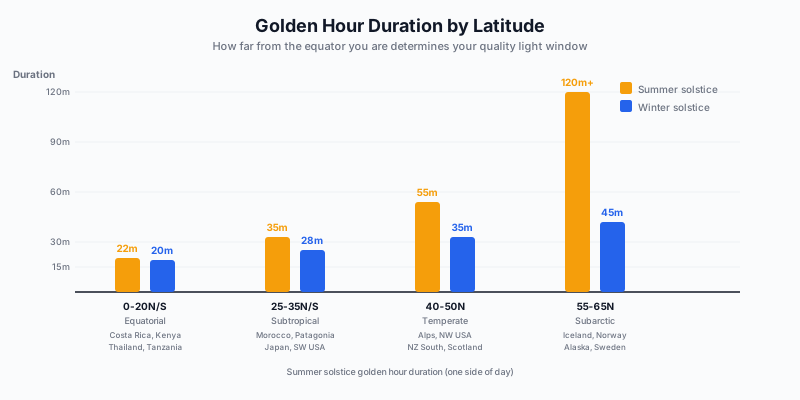
High latitudes (60-70N — Iceland, Norway, Alaska):
- Summer golden hours last 2+ hours, with light that wraps slowly around terrain
- Winter daylight is brief (4-6 hours) but golden hour quality persists much of the day
- Shoulder seasons (September-October, March-April) offer the best balance of light quality and weather
Mid-latitudes (35-50N — Europe, northern US, Japan):
- 30-60 minute golden hours year-round
- Predictable seasonal variation
- Best conditions typically in shoulder seasons
Near equator (0-20N/S — Central America, Southeast Asia, East Africa):
- 20-30 minute golden hours with fast transitions
- Minimal seasonal variation in light quality
- Sunrise and sunset happen quickly — be in position early
Seasonal Subject Timing
| Subject |
Peak Season |
Why |
| Autumn foliage |
Sep-Oct (Northern Hemisphere) |
Peak color before leaf drop |
| Northern lights |
Sep-Mar |
Dark skies + solar activity |
| Wildlife migration |
Varies (July-Oct in East Africa) |
Concentrated animal movement |
| Waterfall volume |
Spring (snowmelt) or post-monsoon |
Maximum flow |
| Clear mountain skies |
Post-monsoon or late autumn |
Washed atmosphere, low humidity |
| Wildflowers |
Spring (varies by altitude and latitude) |
Short bloom window |
| Snow coverage |
Feb-Mar (Northern Hemisphere) |
Deep accumulation before melt |
Avoiding Crowds Without Sacrificing Quality
The worst time to photograph an iconic location is when everyone else is there.
Peak times to avoid: Major holidays, local school vacations, summer high season (June-August in Europe), and viral social media moments (cherry blossom peak, specific northern lights forecasts).
Strategic alternatives:
- Travel the first or last week of shoulder season (early September or late March instead of August or April)
- Visit on weekdays rather than weekends at accessible locations
- Embrace weather that discourages other visitors — overcast, misty, and drizzling conditions produce moody images that sunny-day tourists never capture
Building a Shot List
Priority Classification
Not all shots are equal. Classify them to manage your limited time and energy.
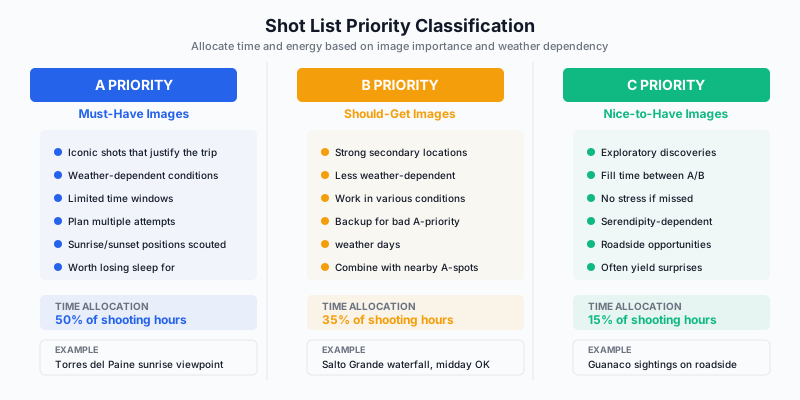
A Priority — Must-have images:
- Iconic shots that justify the trip
- Weather-dependent (require specific conditions to work)
- Limited time windows (sunrise at a specific location)
- Plan multiple attempts across different mornings
B Priority — Should-get images:
- Strong compositions at secondary locations
- Less weather-dependent (work in various conditions)
- Backup options during adverse weather at A-priority locations
C Priority — Nice-to-have images:
- Exploratory discoveries
- Fill time between A and B priorities
- No stress if weather or logistics prevent them
Shot List Template
| Location |
Priority |
Best Light |
Conditions Needed |
Lens |
Notes |
| Torres Sunrise Viewpoint |
A |
Pre-dawn, 4 AM start |
Clear sky, calm wind |
16-35mm |
2hr hike from Refugio Chileno |
| Lago Pehoe |
A |
Sunrise |
No wind (reflections) |
24-70mm |
Drive 20 min from hotel |
| Salto Grande |
B |
Midday OK |
Any |
16-35mm + ND filter |
Near Lago Pehoe, combine trips |
| Guanaco Sightings |
C |
Anytime |
Luck, patience |
70-200mm |
Roadsides throughout park |
Weather Contingency Planning
Every A-priority location needs a backup plan for bad weather:
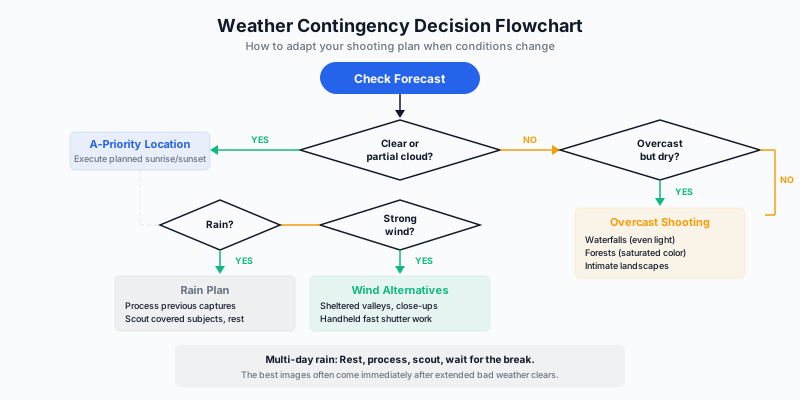
- Overcast backup: Waterfalls, slot canyons, forests — scenes where diffused light is actually preferable
- Wind backup: Close-up and macro subjects, sheltered valleys
- Rain backup: Urban architecture, covered markets, cultural subjects
- Multi-day rain: Rest, process images, scout for when weather breaks
Bruce Barnbaum writes in The Art of Photography that some of his strongest work came from conditions he initially considered failures. Fog, mist, and flat light create atmosphere that sunshine cannot replicate.
Logistics Management
Accommodation for Photographers
Standard travel logic (central location, late checkout, pool) does not apply. Photography logic is different.
Questions to ask before booking:
- How far is the nearest sunrise location? (Under 30 minutes is ideal)
- Can I leave before dawn without waking the entire guesthouse?
- Is there a secure place to charge and store equipment?
- Is WiFi reliable enough for backup uploads?
- Can they prepare an early breakfast or packed lunch?
Position trumps comfort. A basic cabin 15 minutes from your A-priority sunrise is worth more than a luxury hotel 90 minutes away.
Vehicle Requirements
Standard rental sufficient:
- Paved roads throughout
- Moderate distances between locations
- Coastal or lowland terrain
4WD mandatory:
- F-roads in Iceland (legally required)
- High-altitude mountain passes
- Desert and gravel tracks
- River crossings (some of which your insurance does not cover — verify)
Always rent the vehicle you actually need, not the vehicle you hope you need. Being stuck on a mountain track with a compact sedan costs more — in time, stress, and towing fees — than the 4WD surcharge.
Guides vs. Self-Guided
Hire a guide when:
- First visit to a logistically complex destination
- Wildlife photography where finding subjects requires local knowledge
- Permit or access requirements that only locals can navigate
- Limited time where efficiency matters more than freedom
Self-guide when:
- Return visits where you know the terrain
- Maximum flexibility is the priority
- Budget is constrained
- The destination has simple, well-marked infrastructure
Pre-Trip Preparation
Gear Testing (Two Weeks Before Departure)
Every piece of equipment must be tested before it goes in the bag. Not checked — tested.
- Shoot at every focal length with every lens you are bringing
- Verify autofocus accuracy (test charts or known targets)
- Confirm image stabilization works at slow shutter speeds
- Test your tripod head locks and plate attachment
- Format cards and verify read/write speeds
- Update firmware on all bodies, lenses, and drones
Discovering a firmware bug or a sticky zoom ring on location is a failure of preparation, not bad luck.
Permits and Regulations
Research requirements for:
- National park access and photography permits
- Drone flying permissions (many national parks and countries ban or restrict drones)
- Cultural or religious site photography rules
- Commercial photography licensing (if selling images)
- Border crossing with equipment (customs declarations for high-value gear)
Physical Preparation
Photography expeditions are physically demanding in ways that catch desk workers off guard.
- Hiking conditioning: If your expedition involves trail access to shooting locations, train for it. A 6-mile round trip with a 15 kg pack at altitude is not a casual walk.
- Altitude awareness: Above 3,000m, acclimatization matters. Plan 1-2 days at moderate altitude before pushing higher.
- Sleep deprivation management: Pre-dawn starts on consecutive days compound fatigue. Build in rest mornings where you skip sunrise.
During the Expedition
Adapting to Reality
No plan survives contact with weather.
Flexibility principles:
- Check weather forecasts at least three times daily (morning, midday, evening)
- Know your backup locations before you need them
- Accept weather gifts — an unexpected clearing at a B-priority location may produce a better image than a mediocre morning at your A-priority
- Do not force shots in poor conditions. A bad image of a great location does not become a great image because the location is famous.
Energy Management
Multi-day expeditions require managing your physical and creative energy as carefully as your battery supply.
- Not every sunrise matters equally: If conditions are clearly unfavorable, sleep in. You will be sharper for the following morning.
- Build in processing days: Half-days spent culling and processing keep your card capacity healthy and give you perspective on what you have captured versus what you still need.
- Eat and hydrate properly: This sounds obvious. But photographers who skip breakfast to chase first light and then spend four hours in wind and cold are making decisions on depleted resources.
Daily Backup Routine
Every evening, without exception:
- Copy all cards to laptop
- Verify copies are readable
- Copy to external SSD
- Quick cull of obvious failures
- Format cards only after backup is verified on two devices
Group vs. Solo Expeditions
Solo Photography Travel
Advantages: Total schedule control, no compromise on locations or pace, solitude for creative focus, ability to change plans instantly.
Challenges: Safety in remote areas, higher per-person costs (vehicle, lodging), no one to share logistics, no built-in motivation on bad-weather days.
Group Photography Travel
Advantages: Shared vehicle and lodging costs, safety in numbers, collaborative creativity and real-time feedback, social motivation.
Challenges: Schedule compromise, different fitness and skill levels, competition for compositions at small viewpoints, waiting for the slowest member.
Guided Photography Tours
Consider a guided tour when the destination is logistically complex, when wildlife requires expert finding, or when you want to learn from a photographer who knows the location intimately. The best photography tour leaders are not guides who take photos — they are photographers who guide.
Exercises
Exercise 1: Virtual Scout a New Location
Choose a destination you have never visited. Using only PhotoPills, Google Earth Pro, Instagram, and Weather Spark, create a complete 3-day shot list with A/B/C priorities, sunrise/sunset positions, and weather contingency plans. Do not use any travel guide or photography blog — work only from primary data.
Exercise 2: The One-Day Weather Drill
On your next available day, check the weather forecast at 6 AM. Based on conditions, build a shot list for the day from locations within one hour of home. Execute the plan, adapting to weather changes as they occur. Review in the evening: how many of your planned shots worked, and which unplanned images were stronger?
Exercise 3: Pack and Time Your Departure
Do a full departure rehearsal. Pack your expedition kit the night before. In the morning, time everything from alarm to walking out the door with a loaded bag, verified cards, and charged batteries. Identify where you lose time. Reduce your departure time by 25% through better systems.
Exercise 4: Post-Expedition Audit
After your next trip, review your shot list against your final selects. Calculate the ratio of planned shots to unplanned discoveries in your best 20 images. Use this data to calibrate the detail level of future shot lists — are you over-planning or under-planning?
The Plan Is Not the Point
The point of planning a photography expedition is not to execute the plan. It is to arrive prepared, positioned, and mentally free to respond to what the landscape offers. The best image from your trip may come from a location that was not on your list, during weather you had written off, using a lens you almost left at home.
But you were there. Your batteries were charged. Your cards were formatted. And your mind was not occupied with wondering where to eat dinner, whether your car could handle the road, or how to find the trailhead in the dark.
That is what planning produces: not certainty, but readiness. And readiness, in photography as in most endeavors worth pursuing, is the closest you can get to making your own luck.