The Tripod Plate Was Still on the Kitchen Counter
You have flown fourteen hours to Patagonia. The sunrise over Torres del Paine is forty minutes away. You open your bag, mount the camera on the tripod, and reach for the Arca-Swiss plate. It is not in the bag. It is not in any pocket. It is sitting on your kitchen counter, 8,000 miles away, exactly where you left it after testing your new tripod head.
Your $5,000 setup cannot mount to a tripod. You will handhold for the next ten days.
This article exists because of that photographer. And the one who packed lithium batteries in a checked bag and had them confiscated. And the one whose $3,000 lens arrived in Reykjavik with a cracked rear element because the hard case was in the overhead bin during turbulence. Every packing mistake a photographer can make has been made. The system described here prevents them.
The Three-Way Trade-Off
Every packing decision balances three competing priorities:
Protection: Fragile optical equipment must survive airline baggage handlers, rain, dust, temperature swings, and your own fatigue-induced clumsiness at 4 AM.
Accessibility: Gear you cannot reach quickly is gear you will not use when conditions demand it. A lens buried at the bottom of a bag might as well be at home.
Weight: Every gram counts on a ten-hour hike. And every airline has a carry-on weight limit that you will eventually need to negotiate.
The professionals who do this for a living have converged on systems that optimize all three — and they are not the systems most amateurs expect.
Choosing the Right Bag System
Dedicated Camera Backpacks
Best for: Day shoots, vehicle-based travel, short hikes
| Bag |
Capacity |
Weight |
Access Style |
| Peak Design Travel Backpack 45L |
2 bodies + 5 lenses |
2.05 kg |
Rear panel |
| F-Stop Ajna 40L |
2 bodies + 6 lenses + drone |
2.7 kg |
Top + ICU |
| Lowepro ProTactic 450 AW II |
2 bodies + 4 lenses |
2.3 kg |
Side + top |
| Shimoda Explore V2 35L |
1 body + 4 lenses |
1.8 kg |
Rear panel |
Advantage: Purpose-built dividers, integrated rain covers, quick-access panels designed for camera bodies.
Disadvantage: They look like camera bags. In some destinations, this makes you a target. They are also designed by camera bag companies, not hiking companies — so comfort on long treks is often mediocre.
Internal Camera Units (ICUs)
Best for: Multi-day treks, security-conscious travel, expeditions where you carry non-camera gear alongside photography equipment.
ICUs are padded, modular inserts that fit inside regular backpacks. You choose the hiking pack for its carry comfort and the ICU for camera protection — each optimized independently.
Top options: F-Stop Pro ICU, Shimoda Core Units, Peak Design Camera Cubes
The stealth advantage: A hiker wearing a Gregory Baltoro looks like a hiker. A hiker wearing an F-Stop Ajna looks like someone carrying $10,000 in electronics. In many places on Earth, that distinction matters.
The Hybrid System (Recommended for Expeditions)
- Quality hiking backpack (60-70L) with ICU insert for trek days
- Small shoulder bag (Peak Design Everyday Sling 6L) for vehicle days and quick excursions
- Hard case (Pelican Air 1535) for checked equipment on flights
This three-bag approach handles every situation: the shoulder bag for grab-and-go, the backpack for all-day carries, the hard case for transit protection.
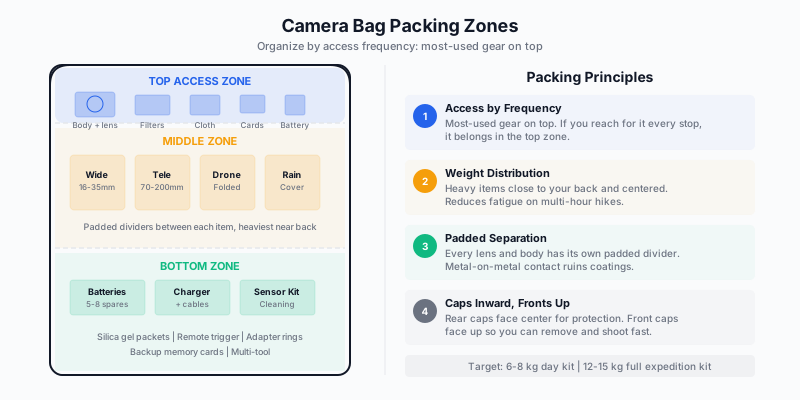
Packing by Zone
Top Zone: Instant Access
Everything you reach for at every shooting stop:
- Primary camera body with most-used lens attached (always stored lens-down for center-of-gravity)
- Current shooting filters (polarizer, ND)
- Spare battery (one, fully charged)
- Memory cards in a card wallet
- Lens cloth
Middle Zone: Session Gear
Equipment you change between locations but not at every stop:
- Secondary lenses (wide-angle, telephoto)
- Drone (folded, propellers attached)
- Rain cover for camera
- Lens cleaning pen
Weight rule: Heaviest items closest to your back and centered vertically. This transfers weight to your hips through the pack’s suspension system rather than pulling you backward.
Bottom Zone: Support Gear
Items you access at the beginning and end of the day, not during active shooting:
- Spare batteries (remaining)
- Battery charger and cables
- Sensor cleaning kit
- Backup memory cards
- Remote trigger / intervalometer
- Adapter rings and step-up rings
- Silica gel packets
Lens Organization Specifics
Pack lenses with rear caps facing toward the bag’s center and front caps facing outward (up). This protects the more vulnerable rear element during transit while allowing you to remove the front cap and mount the lens in a single motion.
Always place a padded divider between each lens. Metal-to-metal or glass-to-metal contact during a stumble on uneven terrain is how coatings get scratched and barrels get dented.
Air Travel: Rules That Actually Matter
The Non-Negotiable Rule
Never check irreplaceable equipment. Camera bodies, lenses, memory cards with images on them — these go in your carry-on. Full stop. Airline liability for damaged checked luggage is laughably low compared to the value of professional photography equipment.
Carry-On Dimensions and Weight Limits
| Airline |
Max Carry-On Size |
Weight Limit |
| United / Delta / American |
22” x 14” x 9” |
None specified |
| British Airways |
22” x 18” x 10” |
23 kg (51 lbs) |
| Emirates |
22” x 15” x 8” |
7 kg (15 lbs) |
| Ryanair |
15.7” x 9.8” x 7.9” |
10 kg |
| EasyJet |
17.7” x 13.8” x 9.8” |
No limit |
| Icelandair |
21.5” x 15.5” x 7.9” |
10 kg |
Budget carrier warning: Ryanair and EasyJet enforce strictly. Weigh and measure your bag at home. Showing up with a 12 kg bag on a 10 kg airline means gate-checking your cameras — exactly the disaster you are trying to avoid.
Pro technique: Wear a photo vest or jacket with large pockets. Move heavy items (spare batteries, filters, chargers) to your person before approaching the gate. Your jacket is not checked or weighed.
Lithium Battery Regulations
This is not optional guidance — it is international aviation law:
- All spare lithium-ion batteries: Must be in carry-on luggage. Banned from checked bags.
- Under 100 Wh: No quantity limit. Most camera batteries (Sony NP-FZ100 = 16 Wh) fall here.
- 100-160 Wh: Maximum 2 spare per passenger. Large drone batteries (DJI Mavic 3 Intelligent Flight Battery = 77 Wh) are under 100 Wh — check your specific battery.
- Over 160 Wh: Prohibited on commercial aircraft.
Tape exposed terminals on spare batteries with electrical tape. This is a regulation, not a suggestion.
Protection Against Weather
Humidity and Tropical Environments
Silica gel packets: Include 3-5 in your camera bag. They absorb moisture that causes fungus on lens elements and corrosion on electronic contacts. Replace when the indicator color changes (typically blue to pink).
Camera rain covers: A purpose-built cover like the Peak Design Shell is worth its weight. The emergency alternative — a plastic bag with a hole cut for the lens — works in a pinch but offers no protection at the rear or bottom.
Dry bags: For kayaking, river crossings, or any situation where submersion is possible, a roll-top dry bag (Sea to Summit Ultra-Sil) inside your camera bag provides waterproof last-resort protection.
Cold Weather Protocol
The camera-destroying mistake in cold weather is not the cold itself — it is the transition from cold to warm. When you bring a freezing camera into a heated lodge, moisture condenses on every surface, including inside the lens and on the sensor.
Prevention protocol:
1. Before entering any warm space, place the camera in a sealed plastic bag (a large Ziploc works)
2. Seal the bag completely
3. Allow 30-45 minutes for the camera to warm to room temperature inside the sealed bag
4. Open the bag only when the camera is fully warm
Battery management in cold: Lithium-ion batteries lose 40-50% of their capacity in extreme cold. Carry spares in an inside pocket against your body. Rotate cold batteries to body warmth, warm batteries to the camera.
Dust and Sand
- Change lenses inside a vehicle, tent, or jacket — never in open air in dusty or sandy environments
- Replace rear caps immediately upon removing a lens
- Drape a lens cloth over the camera body when not actively shooting
- Plan for sensor cleaning after every sandy shoot — even with careful lens changes, fine particles find their way in
Memory Card Strategy and Field Backup
The 3-2-1 Backup Rule
- 3 copies of every image
- 2 different storage media types
- 1 copy physically separated from the others
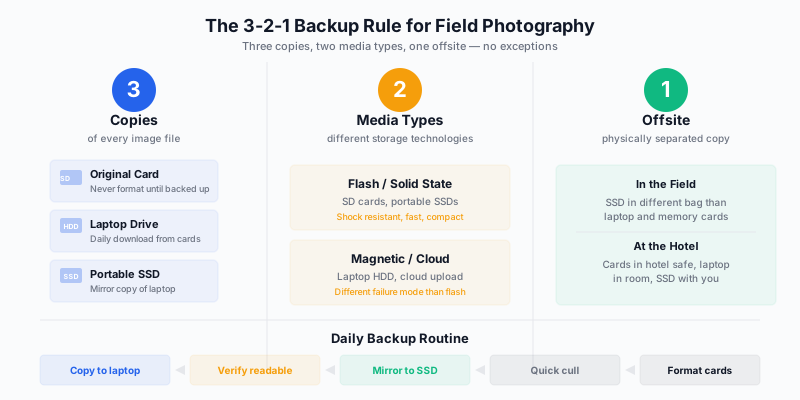
On a photography expedition, this means:
- Original cards stay in the camera (or card wallet) — never formatted until backed up
- Laptop hard drive: Daily download of all cards
- Portable SSD: Mirror copy of the laptop download, stored in a different bag
Camera Dual-Slot Strategy
If your camera has dual card slots, use mirror mode (both cards record identical data). This gives you an instant second copy with zero extra effort. In overflow mode or sequential mode, a card failure means lost images.
Daily Backup Routine
Every evening, without exception:
- Copy all cards to laptop
- Verify copies are readable (open 2-3 random files)
- Copy the same files to portable SSD
- Quick cull of obvious failures (saves backup space)
- Format cards only after backup verification
Never keep all your cards in one place. If the bag with your laptop also has your card wallet, a single theft wipes out everything. Distribute cards between bags, pockets, and hotel safes.
The Minimal Kit vs. The Comprehensive Kit
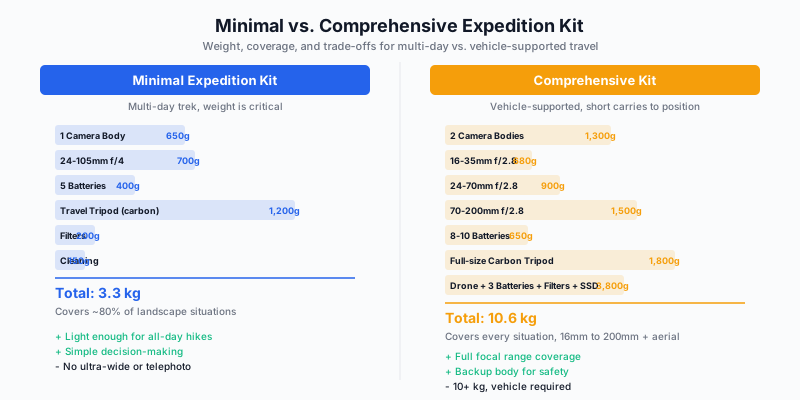
Minimal Expedition Kit (Multi-Day Trek)
| Item |
Weight |
| 1 camera body |
650g |
| 24-105mm f/4 zoom |
700g |
| 5 batteries |
400g |
| Travel tripod (carbon) |
1,200g |
| Filter kit (CPL + 6-stop ND) |
200g |
| Cleaning supplies |
150g |
| Total |
~3.3 kg |
One zoom lens that covers 24-105mm handles 80% of landscape situations. You lose the ultra-wide and the telephoto compression, but you gain weight savings and simplicity. David duChemin argues in Within the Frame that creative constraints often produce stronger work.
Comprehensive Expedition Kit (Vehicle-Supported)
| Item |
Weight |
| 2 camera bodies |
1,300g |
| 16-35mm f/2.8 |
680g |
| 24-70mm f/2.8 |
900g |
| 70-200mm f/2.8 |
1,500g |
| 8-10 batteries |
650g |
| Full-size carbon tripod |
1,800g |
| Drone + 3 batteries |
1,400g |
| Complete filter system |
600g |
| Laptop + portable SSD |
1,800g |
| Total |
~10.6 kg |
This kit covers every situation but weighs over 10 kg before adding any personal gear. It is only practical when you are moving between locations by vehicle and carrying only short distances to shooting positions.
Security and Insurance
Place an Apple AirTag in every bag that contains camera equipment — carry-on and checked. AirTags do not prevent theft, but they provide location data that has, in documented cases, helped recover stolen equipment. The $29 per tracker is the cheapest insurance you can buy.
Travel Insurance for Photography Equipment
Standard travel insurance typically covers $500-$1,000 in personal electronics. Your kit is worth more. You need specific equipment coverage.
Key coverage areas:
- Theft and accidental damage worldwide
- Trip interruption if equipment is stolen and you cannot shoot
- Rental replacement coverage while claim is processed
Document everything before departure: photograph each piece of gear, record serial numbers, keep purchase receipts. Insurance claims without serial numbers are denied more often than approved.
Exercises
Exercise 1: The Weigh-In
Pack your full expedition kit. Weigh it. Then remove items until you reach 7 kg. Shoot a full day with only the reduced kit. Evaluate honestly: did you miss anything you removed? Most photographers discover they can cut 30% of what they habitually carry.
Exercise 2: The 90-Second Drill
Time yourself retrieving and mounting each lens from your packed bag. If any lens takes more than 90 seconds to access, mount, and be ready to shoot, your packing arrangement needs work. Light changes fast at sunrise — every second of fumbling is a second of lost opportunity.
Exercise 3: The Airport Simulation
Weigh and measure your carry-on bag against the strictest airline you might fly. If it exceeds the limit, practice redistributing weight to pockets and jacket. Know exactly what you need to move before you are standing at a gate agent’s counter.
The Gear You Forgot
Every photographer who travels enough eventually develops a pre-departure checklist that they verify the night before every trip. Not a mental review — a physical, item-by-item verification.
The professionals do not trust themselves to remember. They trust their systems. A checklist taped inside your camera bag lid, a departure routine that happens in the same order every time, a packing layout on a table where every item has an assigned position — these systems catch the tripod plate before it reaches the kitchen counter.
Galen Rowell, one of the greatest adventure photographers, was legendary for traveling with minimal gear. But he was equally legendary for never forgetting a critical piece. Minimalism is not about owning less. It is about knowing exactly what you need, where it is, and that it works — every time you walk out the door.