The Difference You Cannot Spec-Sheet
You can compare megapixel counts, measure dynamic range in stops, and benchmark autofocus speed in frames per second. All of these are quantifiable, and all of them tell you almost nothing about why a medium format image looks different from a full-frame image.
The difference lives in tonal gradation, the smoothness with which a sky transitions from deep blue to pale horizon, the way a shadow under a cliff face contains seventeen shades of gray instead of seven, the manner in which skin tones render with a dimensional quality that has nothing to do with sharpness or resolution. It is the visual quality that makes a Hasselblad print feel like you could reach into it and touch the rock face.
This quality is not marketing mythology. It is a direct consequence of physics. A larger sensor with larger photosites captures more photons per pixel, producing deeper bit depth, wider dynamic range, and smoother tonal transitions at the analog-to-digital conversion stage. The result is a RAW file that contains more information in every tonal zone, giving you processing latitude that full-frame files, even excellent ones, cannot match.
This guide is for photographers who already shoot at a high level with full-frame equipment and are considering, or have recently acquired, a medium format system for their landscape work. It covers the practical realities of using these cameras in the field: what they do better, what they do worse, and how to adapt your technique to extract the most from the larger sensor.
The most common misconception about medium format is that its advantage is resolution. It is not. A 100-megapixel medium format sensor does resolve more detail than a 45-megapixel full-frame sensor, but a modern 61-megapixel full-frame body like the Sony A7R V resolves an enormous amount of detail already. If resolution were the only variable, medium format would not be worth its weight, cost, and operational compromises.
The actual advantages are more subtle and more significant:
Tonal Depth and Color Gradation
The 44x33mm sensor in the Hasselblad X2D II 100C has 1,441 square millimeters of light-gathering area, 1.67 times the 864 square millimeters of a full-frame sensor. At 100 megapixels, its photosites are approximately 3.76 micrometers, similar in size to a 61-megapixel full-frame sensor. But the sensor architecture, 16-bit analog-to-digital conversion, and the overall system design produce files with measurably smoother tonal gradation.
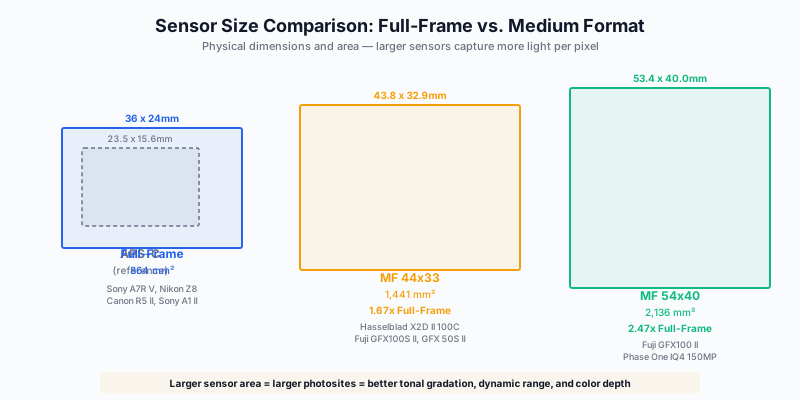
The practical impact: when you process a medium format file and push a sky gradient, you do not see banding. When you lift shadows under a mountain ridge, the tonal information is continuous rather than stepping between discrete levels. When you print at 30 by 40 inches and stand three feet away, the transitions between tonal zones are seamless in a way that a full-frame file, even an excellent one, sometimes struggles to achieve.
Galen Rowell, whose work in Mountain Light demonstrates mastery of the most demanding light on Earth, built his reputation on midtone rendering, the conviction that the finest landscape photographs distinguish themselves not in their highlights or shadows but in the subtlety between them. Medium format excels precisely here: the midtone rendering has a three-dimensional quality that comes from capturing more data in the tonal zones where the human eye is most perceptive.
Dynamic Range
The Hasselblad X2D II 100C delivers approximately 15.3 stops of dynamic range at base ISO. The Fuji GFX100 II delivers approximately 14.5 stops. Both exceed what the best full-frame sensors achieve by a measurable margin. This translates directly to more recoverable highlight and shadow information in high-contrast landscape scenes.
Color Accuracy and Depth
Hasselblad’s Natural Colour Solution (HNCS) has been refined over decades, originally for commercial product photography where color accuracy is contractually required. In landscape work, HNCS produces colors that feel dimensional and accurate, particularly in earth tones, foliage greens, and sky blues where full-frame cameras often produce a flatter, more two-dimensional rendition.
Fuji’s GFX color science, derived from decades of film emulsion research, has its own character: slightly warmer, with a rendering of greens and blues that many landscape photographers prefer. The Fuji GFX color rendition has an organic quality that film photographers consistently describe as familiar.
The Leaf Shutter Advantage
Every lens in the Hasselblad XCD system contains a built-in leaf shutter. This is not a minor specification footnote. It is a fundamental advantage for landscape photography that most medium format discussions understate.
What Leaf Shutters Do Differently
A leaf shutter opens from the center outward, like an iris. A focal plane shutter (used in all full-frame mirrorless cameras) travels across the sensor as a moving slit. The mechanical vibration from a leaf shutter is dramatically lower than from a focal plane shutter, which is why Hasselblad cameras have historically produced sharper results on a tripod at moderate shutter speeds (1/4 second to 1/60 second) where shutter shock is most problematic.
Modern mirrorless cameras mitigate shutter shock with electronic first curtain shutter (EFCS) modes, but Hasselblad’s leaf shutters eliminate the issue entirely. On a tripod at shutter speeds between 1/8 and 1/60 second, where landscape photographers spend enormous amounts of time, the leaf shutter produces consistently sharper results.
Flash Sync at Any Speed
Leaf shutters sync with flash at any shutter speed, including 1/2000 second. For landscape photographers, this means using fill flash on foreground elements in bright daylight without needing high-speed sync, which reduces flash power. If you photograph wildflowers against a sunset or use flash to illuminate ice cave interiors while balancing ambient exposure, leaf shutter sync is genuinely useful.
ND-Free Long Exposure
Hasselblad XCD leaf shutter lenses have a maximum aperture typically around f/2.5 to f/4, and the smallest aperture stops at f/22 to f/32. Combined with the electronic shutter option for exposures up to 246 seconds, you can achieve longer base exposures without ND filters in lower light. This does not eliminate the need for ND filters in bright conditions, but it reduces filter dependency during golden hour and blue hour shooting.
Hasselblad X2D II vs. Fuji GFX100S II: Field Handling Compared
Both systems produce exceptional image quality. The choice between them often comes down to handling, workflow, and the specific demands of your shooting style.
| Feature |
Hasselblad X2D II 100C |
Fuji GFX100S II |
| Sensor |
100MP, 44x33mm |
102MP, 43.8x32.9mm |
| Dynamic Range |
~15.3 stops |
~14.5 stops |
| Body Weight |
~730g |
~883g |
| IBIS |
Yes (7 stops) |
Yes (7 stops) |
| Autofocus |
Phase detect, LiDAR assist |
Phase detect, fast |
| Weather Sealing |
IP54 rated |
Extensive sealing |
| EVF Resolution |
5.76M dots |
5.76M dots |
| Max Shutter Speed |
1/4000 (mechanical), 1/10000 (electronic) |
1/4000 (mechanical), 1/16000 (electronic) |
| Card Slots |
1x CFexpress Type B |
1x CFexpress Type B |
| Battery Life |
~327 shots (CIPA) |
~530 shots (CIPA) |
| Street Price |
~$7,399 body |
~$4,999 body |
Hasselblad X2D II: The Precision Instrument
The X2D II handles like no other camera in production. The body is machined from a solid aluminum block, and the haptic feedback from every button press and dial rotation conveys a sense of mechanical precision that no other manufacturer achieves. It is 153 grams lighter than the Fuji GFX100S II despite comparable dimensions.
The LiDAR-assisted autofocus system provides focus confirmation in near-total darkness, which is valuable for landscape photographers working at dawn, dusk, or inside caves and slot canyons. The 10-stop IBIS enables handheld shooting at surprisingly slow shutter speeds for a 100-megapixel sensor.
The limitation: a single card slot. For professional expedition work in remote locations, having no backup card slot introduces risk. The workaround is shooting to internal 1TB SSD (available in the X2D II) plus CFexpress, but this raises the system cost further.
Fuji GFX100S II: The Field-Ready Workhorse
The GFX100S II handles more like a traditional DSLR. The grip is deeper and more ergonomic than the X2D II’s minimalist body, making it more comfortable for extended handheld shooting and for operation with gloves. The autofocus is faster and more confident in tracking moving subjects, which matters for landscape photographers who also shoot wildlife or environmental portraits.
Battery life is substantially better: 530 CIPA shots versus the X2D II’s 327. In cold weather, where battery performance degrades, this margin increases in the Fuji’s favor. For multi-day backcountry expeditions where charging opportunities are limited, the GFX100S II’s power efficiency is a practical advantage.
The Fuji GF lens system offers more zoom options, which provides greater focal length flexibility with fewer lens changes. The GF 20-35mm f/4 alone covers a range that would require two Hasselblad primes to match.
At $4,999 body-only versus the X2D II’s $7,399, the GFX100S II is also meaningfully less expensive. For photographers entering medium format for the first time, the Fuji system offers a lower barrier to entry with comparable image quality.
Pixel Shift Multi-Shot: When and How to Use 400MP Mode
Both the Fuji GFX100 II (the higher-end body) and the Hasselblad X2D II offer pixel shift multi-shot modes that capture multiple frames while physically shifting the sensor by sub-pixel increments. The camera then combines these frames into a single file with dramatically higher resolution and color accuracy.
The Fuji GFX100 II’s pixel shift mode produces 400-megapixel files. The Hasselblad X2D II’s multi-shot mode produces files with enhanced color accuracy and reduced moiré rather than emphasizing raw resolution.
When Pixel Shift Works
- Completely static scenes on a solid tripod: Architectural details, rock formations in still air, museum and gallery reproduction work
- Controlled environments: Studio product photography, art reproduction
- Calm conditions: No wind, no moving water, no swaying vegetation
When Pixel Shift Fails
- Any wind: Even gentle breeze moving grass or leaves creates ghosting artifacts
- Moving water: Rivers, waves, and waterfalls produce doubling and color fringing
- Clouds: Moving clouds create banding in the sky
- Handheld: The technique requires absolute tripod stability
The practical reality is that pixel shift is useful for perhaps 10 to 15 percent of landscape shooting situations. The conditions required, zero movement in any part of the frame, are rare in outdoor environments. When conditions align, however, the results are extraordinary: resolution and color accuracy that exceed what any single-shot digital capture can achieve.
Practical Application
Scout your scene first. If the foreground is stable (solid rock, dry sand, still water), conditions are calm, and the sky is either clear or overcast with no visible cloud movement, pixel shift is worth the capture time. If any element is moving, shoot standard single frames and invest the time in focus stacking instead.
Focus Stacking with Larger Sensors
Medium format sensors produce shallower depth of field than full-frame sensors at equivalent field of view and aperture. This is a direct consequence of the longer focal lengths required to achieve the same angle of view on the larger sensor.
A 30mm lens on medium format provides approximately the same field of view as a 24mm lens on full-frame. But the depth of field at f/8 is shallower with the 30mm lens on the larger sensor, roughly equivalent to shooting at f/6.3 on full-frame. This means scenes that were entirely sharp in a single full-frame exposure may require focus stacking on medium format.
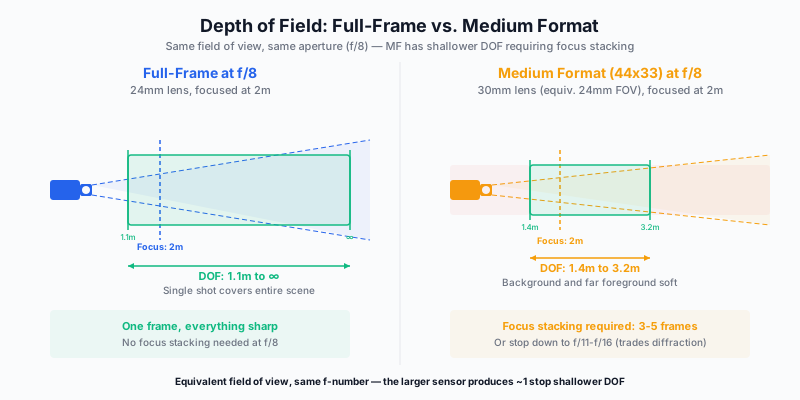
The Focus Stacking Workflow
- Determine your near and far focus points. What is the closest element you need sharp? What is the farthest?
- Set aperture to f/8. This is the optical sweet spot on most medium format lenses. Avoid f/16 and smaller to prevent diffraction softening, which is more visible on high-resolution sensors.
- Focus on the nearest element. Take the first frame.
- Shift focus incrementally toward infinity. Each frame should overlap the previous frame’s sharp zone by roughly 30 percent.
- Typical stack count: 3 to 7 frames. Close foreground to infinity at f/8 on medium format usually requires 3 to 5 frames. Macro-distance foreground elements may require 7 or more.
- Stack in Helicon Focus or Zerene Stacker. Both handle medium format files well. Helicon Focus’s Method B (depth map) typically produces the cleanest results for landscape stacks.
When to Stop Down Instead
For scenes where focus stacking is impractical (wind moving vegetation, time-critical light), stopping down to f/11 or f/13 extends depth of field at the cost of some diffraction softening. On a 100-megapixel sensor, diffraction begins to visibly soften the image around f/11 to f/13. This softening is mild and often acceptable, but it is measurable at 100% zoom. The trade-off between diffraction softening and insufficient depth of field is a judgment call that depends on the specific scene.
Bruce Barnbaum, in The Art of Photography, argues that sharpness is subordinate to depth in every sense. A focus-stacked medium format image that renders every plane with crystalline precision and seamless tonal gradation embodies that principle.
Lens Selection: Essential Glass for Each System
The lens you mount on a medium format body determines what you can photograph and how much weight you carry. Both Hasselblad and Fuji offer mature lens lineups with distinct philosophies.
The Hasselblad Prime Philosophy
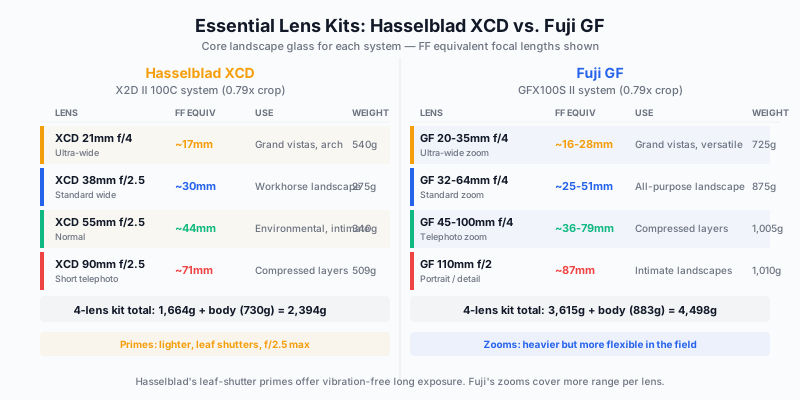
Hasselblad’s XCD lens lineup is dominated by primes with leaf shutters, though the system also includes zooms like the XCD 35-75mm f/3.5-4.5. The advantages of the primes: each lens is optimized for a single focal length, producing maximum optical performance with minimal size and weight. The XCD 38mm f/2.5 weighs just 275 grams and produces images that are sharp to the extreme corners at every aperture from f/2.5 through f/16.
The trade-off: you carry more lenses to cover the same range that a single zoom would handle. A three-prime kit (21mm, 38mm, 90mm) covers ultra-wide through short telephoto at a combined weight of 1,324 grams, substantially lighter than Fuji’s equivalent zoom range.
The Fuji Zoom Strategy
Fuji’s GF zoom lenses are optically excellent and provide focal length flexibility that primes cannot match. The GF 20-35mm f/4 alone covers a range equivalent to 16-28mm on full-frame. Two zooms (20-35mm and 45-100mm) cover the entire landscape range with no gaps.
The trade-off: each zoom weighs more than a single Hasselblad prime. The GF 20-35mm f/4 weighs 725 grams; the XCD 21mm f/4 weighs 540 grams. Over a full kit with three to four lenses, the weight difference between the Fuji zoom approach and the Hasselblad prime approach can exceed a kilogram.
The Minimum Landscape Kit
For a focused landscape expedition where you must carry everything on your back:
Hasselblad minimum: XCD 21mm f/4 + XCD 55mm f/2.5 = 880g (two lenses)
Fuji minimum: GF 20-35mm f/4 = 725g (one lens, more range)
Both minimalist kits cover the most essential landscape focal lengths. The Hasselblad kit gives you a wider ultra-wide and a normal-length lens with a faster aperture. The Fuji kit gives you continuous zoom flexibility in a single lens.
The persistent criticism of medium format is weight. It is a legitimate concern but one that has improved dramatically with the current generation of cameras.
Realistic Kit Weights
| Kit Configuration |
Hasselblad X2D II |
Fuji GFX100S II |
| Body only |
730g |
883g |
| Body + one wide lens |
1,270g (+ XCD 21mm) |
1,608g (+ GF 20-35mm) |
| Body + two-lens landscape |
1,610g (+ 21mm, 55mm) |
1,883g (+ 20-35mm, GF 63mm) |
| Body + three-lens expedition |
2,119g (+ 21mm, 55mm, 90mm) |
2,763g (+ 20-35mm, 45-100mm) |
For comparison, a Sony A7R V with 14mm f/1.8 GM, 24-70mm f/2.8 GM II, and 70-200mm f/2.8 GM II weighs approximately 2,900 grams. The Hasselblad three-lens expedition kit is actually lighter while covering a similar equivalent focal length range.
The weight penalty of medium format is real but smaller than many photographers assume, particularly with the Hasselblad prime lens approach.
The Hybrid Kit Strategy
Many professional landscape photographers do not choose between medium format and full-frame. They carry both. The medium format body handles the primary landscape work: tripod-mounted compositions shot at base ISO in controlled conditions. The full-frame body handles situations where medium format struggles: fast-moving wildlife encounters, handheld shooting in poor light, rapid composition changes.
A practical hybrid kit: Hasselblad X2D II with XCD 38mm f/2.5 (1,005g) plus Sony A7R V with 24-70mm f/2.8 GM II (1,428g). Total: 2,433g for two systems that complement each other’s strengths.
Medium format is not universally superior. There are situations where full-frame systems outperform it, and pretending otherwise serves no one.
Low Light and High ISO
Medium format sensors, despite their size advantage, do not outperform the best full-frame sensors at high ISO. The Sony A1 II and Nikon Z8 produce cleaner files at ISO 6400 and above than the Hasselblad X2D II or Fuji GFX100S II. For astrophotography, low-light wildlife, or any situation demanding ISO 3200 and beyond, full-frame remains the better tool.
Action and Fast Subjects
The Hasselblad X2D II’s autofocus is accurate but not fast by full-frame standards. It was not designed for tracking moving subjects. The Fuji GFX100S II is better but still trails the Sony A1 II, Nikon Z8, and Canon R5 II in continuous autofocus performance. For wildlife, sports, or any subject requiring rapid AF tracking, full-frame is the correct choice.
Cold Weather
Battery performance degrades in cold temperatures, and medium format cameras are not immune. The Hasselblad X2D II’s 327-shot CIPA rating drops substantially below freezing. In conditions below -15 degrees Celsius, battery life can fall to 150 to 200 shots. The Fuji GFX100S II’s larger battery provides more cold-weather endurance but still requires spare batteries kept warm against the body.
Rapid Composition Changes
The methodical, tripod-centered workflow that medium format rewards does not suit every shooting style. If you work quickly, responding to changing light by repositioning rapidly and shooting handheld at multiple focal lengths in quick succession, full-frame systems with versatile zoom lenses are more practical. Medium format rewards patience and deliberation. It punishes hurry.
Buffer and Burst Rate
Medium format files at 100 megapixels are large. The X2D II’s buffer clears slowly after consecutive shots. The GFX100S II manages 5.3 frames per second but fills its buffer after approximately 13 RAW frames. If you rely on burst shooting for any part of your workflow, medium format will test your patience.
Making the Decision: Who Should Invest
Medium format is not a casual upgrade. It is a deliberate investment in a specific kind of image quality that serves a specific kind of photographer.
Invest if: You print large. You exhibit or sell fine art prints at 30 inches and above. You shoot primarily landscapes, architecture, or studio work. You value tonal depth and color accuracy above all other image qualities. You work methodically from a tripod. You have the budget for a system that may cost $10,000 to $20,000 with lenses.
Stay full-frame if: You prioritize versatility. You shoot across multiple genres. You need fast autofocus for any part of your work. You shoot primarily in low light. You value a single do-everything system over a specialized tool.
The honest truth: For web-sized images and prints under 20 inches, the difference between a well-processed medium format file and a well-processed full-frame file is subtle to the point of invisibility. The medium format advantage becomes clearly visible at large print sizes, in demanding lighting conditions, and in the hands of a photographer who knows how to extract the maximum quality from the larger sensor.
David duChemin, in Within the Frame, writes that your equipment should serve your vision, not the other way around. If your vision demands the finest possible tonal rendering at the largest possible print size, medium format is the tool that delivers it. If your vision demands flexibility, speed, and a single-system solution, the current generation of full-frame cameras has never been better.
Exercise 1: The Tonal Comparison Print
Shoot the same landscape scene, same composition, same light, with your medium format body and your full-frame body. Process both files identically in Lightroom. Print both at 24 by 36 inches. Study the midtone transitions, shadow detail, and sky gradations at normal viewing distance and up close. This exercise reveals exactly where the medium format advantage lives in your specific printing workflow.
Exercise 2: Focus Stack Calibration
Set up a scene with a close foreground element (a rock, a flower) 1 meter from the lens and a distant background at infinity. At f/8, shoot a focus stack from near to far, incrementing focus by small amounts. Process the stack in Helicon Focus. Then shoot the same scene on full-frame at f/8 in a single frame. Compare the stacked medium format result to the single full-frame frame. This teaches you the DOF difference viscerally.
Exercise 3: The Leaf Shutter Sharpness Test
On a Hasselblad with a leaf shutter lens, shoot a detailed subject at 1/15, 1/8, 1/4, and 1/2 second on a tripod using the mechanical leaf shutter. Then shoot the same subject at the same speeds on your full-frame camera using EFCS. Compare sharpness at 100% zoom. This test quantifies the leaf shutter vibration advantage at the shutter speeds most relevant to landscape photography.
Exercise 4: The Weight-Quality Audit
Weigh your complete medium format kit and your complete full-frame kit. Divide the weight of each kit by its primary sensor resolution. Calculate the grams-per-megapixel of each system. Now take both kits on the same day hike and shoot the same scenes with both. At the end of the day, evaluate whether the image quality difference justifies the weight difference for your specific body, fitness level, and typical shooting conditions.
Conclusion
Medium format is not the future of all photography. It is the present of a specific kind of photography: deliberate, patient, quality-above-all landscape and fine art work where tonal depth and color accuracy are non-negotiable. The current generation of medium format cameras, led by the Hasselblad X2D II 100C and the Fuji GFX100S II, represents the most practical and field-capable large-sensor systems ever made. They are lighter, faster, and more weather-resistant than any previous medium format cameras.
But they remain specialized instruments. A Stradivarius is not the right violin for a folk music session. The craft lies in knowing which tool serves which moment. If you have reached the level where you can see the difference between a good full-frame file and an exceptional medium format file, and if that difference matters to the work you create and the way you present it, medium format will reward every gram you carry and every dollar you invest.