The Lens You Left at Home Is the One You Need
There is a recurring experience in landscape photography that every serious practitioner knows. You have hiked for three hours to reach a viewpoint. The light is perfect. The scene is extraordinary. And the lens you need is in a drawer at home, or worse, in the car at the trailhead. You brought the wrong glass.
This failure is not about budget. Photographers who own fifteen lenses still make this mistake. It is a failure of system thinking, of understanding which focal lengths serve which scenes before you leave the house, and building a travel kit that covers the creative range without breaking your back.
The lens is the most consequential gear decision a landscape photographer makes, more consequential than the camera body. A mediocre sensor behind a great lens produces better images than a great sensor behind a mediocre lens. The lens determines your field of view, your depth of field control, your minimum focus distance, your flare resistance, and the optical resolving power that your sensor depends on. The body captures what the lens delivers. If the lens delivers soft corners, poor contrast, or chromatic aberration, no sensor on earth can fix it.
This guide covers the focal length strategy, optical quality benchmarks, and specific lens recommendations that build a landscape system capable of handling any scene you encounter, from ultra-wide fjord vistas to telephoto mountain compression.
Focal Length: What Each Range Actually Does
Focal length is not just about “how much fits in the frame.” Each focal length range has a distinct visual character that changes how the viewer experiences the photograph.
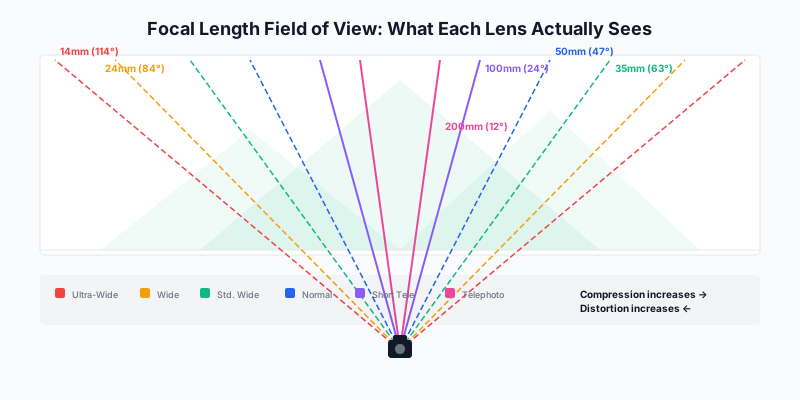
Ultra-Wide (12-20mm)
Character: Expansive, dramatic, immersive. Ultra-wide lenses include massive amounts of foreground, sky, and surrounding context. They create a sense of being there that narrower lenses cannot replicate.
The foreground imperative: An ultra-wide lens without a strong foreground element produces empty, boring images. The foreground occupies a disproportionate share of the frame, and if that foreground is featureless grass or bare rock, the image fails. Every ultra-wide composition demands a foreground anchor: a textured rock, a patch of wildflowers, rippled sand, ice formations, or a leading line that draws the eye into the scene.
Distortion reality: All ultra-wide lenses distort. Straight lines curve toward the edges, and objects at the frame periphery stretch. In-camera and software lens profiles correct most of this distortion, but if your scene contains prominent straight lines (buildings, horizons, trees at the edges), verify that your profile correction handles them.
Landscape applications:
- Grand vistas with prominent foreground: close-up rock formation leading to distant mountain
- Night sky and astrophotography: wider field captures more stars and Milky Way arc
- Interior of natural formations: slot canyons, ice caves, forest canopy looking up
- Environmental context shots: showing a subject within its larger setting
Wide (21-35mm)
The workhorse range for landscape photography. Wide enough to capture expansive scenes, narrow enough to avoid the distortion and foreground dependency of ultra-wide lenses.
24mm: The classic landscape focal length. Wide enough for grand vistas, controlled enough for clean compositions. If you could only own one focal length for landscape work, 24mm would be the rational choice.
35mm: The “standard wide” that sees roughly as the human eye does (though with a wider field). 35mm compositions feel natural and unforced. This is the focal length of photojournalism, documentary, and environmental portraiture. For landscapes, 35mm works when the scene has natural framing that does not require the expansiveness of wider lenses.
Standard (40-60mm)
50mm is the “normal” lens, approximating the field of view and magnification of human vision. In landscape photography, 50mm is underused and underappreciated.
The 50mm landscape argument: A 50mm landscape forces you to compose selectively. You cannot include everything. You must choose what matters, and that discipline often produces stronger images than a wide lens that includes everything and emphasizes nothing.
David duChemin, in Within the Frame, argues that the 50mm forces intimacy with the landscape. You are not documenting the scene; you are interpreting it.
Short Telephoto (70-135mm)
Character: Compression, isolation, intimacy. Short telephoto lenses flatten perspective, bringing distant elements closer together in the frame. Mountains that appear separated by valleys in a wide-angle view stack tightly in a telephoto view, creating a dense, layered composition.
Landscape applications:
- Mountain layering: distant ridgelines compressed into overlapping shapes
- Isolated details: a single tree against a mountainside, a waterfall on a cliff face
- Aerial perspective (haze): telephoto compression through atmospheric layers creates a natural depth gradient
- Desert and sand dunes: compression emphasizes the rhythm of repeating forms
Telephoto (150-600mm)
Character: Extreme compression, abstraction, detail extraction. Telephoto lenses isolate small portions of the landscape, revealing patterns, textures, and relationships invisible to the naked eye.
Landscape applications:
- Mountain summit details: rock textures, snow patterns, ridge geometry
- Wildlife in landscape: a distant animal as a small element in an environmental composition
- Sunrise/sunset compression: the sun or moon appearing large relative to foreground elements
- Wave patterns: isolating repeating wave structures from a coastal cliff
Optical Quality: What Matters and What Does Not
Lens reviews obsess over MTF charts, chromatic aberration measurements, and corner sharpness at maximum aperture. Some of these metrics matter for landscape photography. Others are irrelevant.
What Matters
Corner sharpness at f/8: Landscape photographers shoot at f/8 to f/11. Corner sharpness wide open (f/1.4 or f/2.8) is irrelevant for landscape work. What matters is whether the lens resolves fine detail in the corners at the apertures you actually use. This is where the premium “G Master” (Sony), “S-Line” (Nikon), and “L” (Canon) lenses distinguish themselves from budget alternatives.
Flare resistance: Landscape photographers shoot into the sun regularly. Sunrise, sunset, and backlit scenes are staples of the genre. A lens with poor flare resistance produces ghosting, veiling flare that reduces contrast, and colored artifacts that ruin otherwise strong images. Multi-coated, modern designs with good lens hood coverage handle flare dramatically better than older or budget lenses.
Chromatic aberration control: Color fringing at high-contrast edges (tree branches against sky, building edges against bright backgrounds) degrades image quality in ways that software correction cannot fully fix, especially in print at large sizes.
Distortion profile: Moderate barrel or pincushion distortion is correctable in software. But correction crops the image and can reduce corner resolution. A lens with minimal native distortion preserves your full frame and full resolution.
What Matters Less
Maximum aperture speed: A 14-24mm f/2.8 is essential for astrophotography but overkill for daytime landscape work where you shoot at f/8 anyway. An f/4 ultra-wide is lighter, cheaper, and optically equal at landscape apertures. The exception: night photography and aurora work, where f/2.8 or faster is mandatory.
Autofocus speed: Landscape photography is a deliberate genre. You compose carefully, focus precisely, and shoot from a tripod. AF speed is relevant for wildlife and action; it is rarely the deciding factor for landscape lenses.
Bokeh quality: The out-of-focus rendering that portrait photographers obsess over is largely irrelevant for landscape work, where you shoot at f/8 to f/11 and want everything sharp.
The Sharpness vs. Aperture Curve
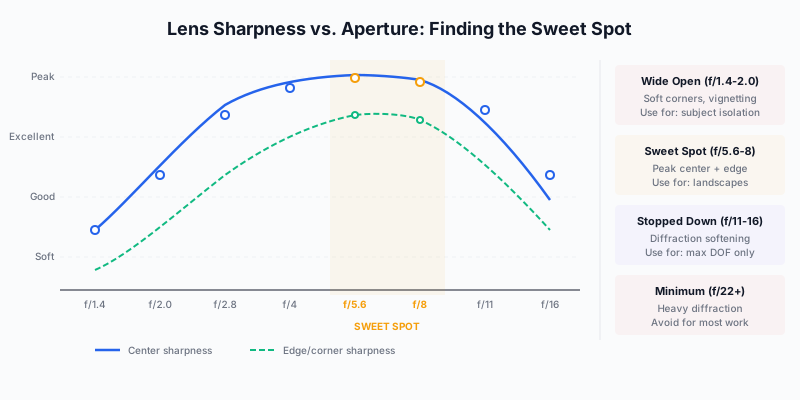
Every lens follows the same general pattern: soft wide open, sharpest at 2-3 stops down (typically f/5.6 to f/8), and progressively softer from f/11 onward due to diffraction. On modern high-resolution sensors (50+ megapixels), diffraction softening becomes visible at f/11 and significant at f/16.
This is why f/8 is the landscape photographer’s default aperture. It combines near-peak sharpness with sufficient depth of field for most scenes. Use f/11 only when you need the additional depth of field, and avoid f/16 or f/22 unless you are focus stacking (where diffraction is compensated by the stacking process) or deliberately seeking a starburst effect on point light sources.
Building the System: Three Tiers
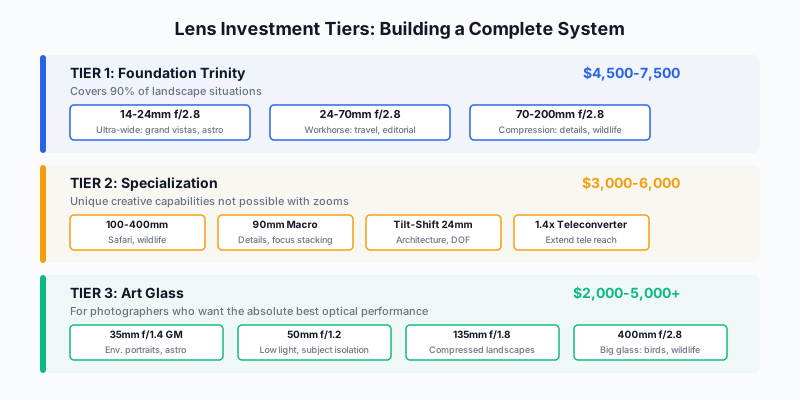
Tier 1: The Foundation Trinity
Three zoom lenses that cover the entire useful focal range for landscape photography. This is the core system that 90% of working landscape photographers rely on.
Ultra-Wide Zoom
| Lens |
Mount |
Weight |
Street Price |
Notes |
| Sony FE 12-24mm f/2.8 GM |
Sony E |
847g |
$2,800 |
Widest f/2.8 rectilinear zoom, exceptional optical quality |
| Nikon Z 14-24mm f/2.8 S |
Nikon Z |
650g |
$2,400 |
Outstanding optical performance |
| Canon RF 14-35mm f/4 L IS |
Canon RF |
540g |
$1,700 |
f/4 but wider range, IS, lighter |
| Sony FE 16-35mm f/2.8 GM2 |
Sony E |
547g |
$2,300 |
Versatile range, exceptional quality |
| Nikon Z 14-30mm f/4 S |
Nikon Z |
485g |
$1,300 |
Best value ultra-wide, accepts front filters |
The Sony FE 12-24mm f/2.8 GM deserves special attention. It is the widest rectilinear f/2.8 zoom available, starting at 12mm where others begin at 14mm. The optical quality is outstanding across the frame, and the extra 2mm at the wide end provides a noticeably wider field of view for astrophotography and grand landscape compositions.
For photographers who do not need f/2.8 (no astrophotography), the Canon RF 14-35mm f/4 L and Nikon Z 14-30mm f/4 S offer exceptional value. The Nikon Z 14-30mm has a flat front element that accepts standard screw-in filters, eliminating the need for expensive filter holder systems.
Standard Zoom
| Lens |
Mount |
Weight |
Street Price |
Notes |
| Sony FE 24-70mm f/2.8 GM2 |
Sony E |
695g |
$2,300 |
Best all-round zoom available |
| Nikon Z 24-70mm f/2.8 S |
Nikon Z |
805g |
$2,300 |
Exceptional resolution |
| Canon RF 24-70mm f/2.8 L IS |
Canon RF |
900g |
$2,400 |
Image stabilized, heaviest |
| Tamron 28-75mm f/2.8 Di III VXD G2 |
Sony E |
540g |
$900 |
Excellent value, lighter, slightly narrower |
The 24-70mm f/2.8 is the workhorse. It covers the most-used focal range for landscape, travel, editorial, and environmental work. The Sony GM2 is the benchmark: sharp across the frame at all focal lengths and apertures, lightweight for its class, and built for professional abuse.
The Tamron 28-75mm G2 deserves consideration for weight-conscious photographers. It sacrifices the 24-28mm wide end and some optical perfection in the corners, but at 540 grams and $900, it is the best value in the category.
Telephoto Zoom
| Lens |
Mount |
Weight |
Street Price |
Notes |
| Sony FE 70-200mm f/2.8 GM2 |
Sony E |
1,045g |
$2,800 |
Lightest f/2.8 70-200, exceptional |
| Nikon Z 70-200mm f/2.8 VR S |
Nikon Z |
1,140g |
$2,700 |
Outstanding, VR built-in |
| Canon RF 70-200mm f/2.8 L IS |
Canon RF |
1,070g |
$2,700 |
Internal zoom (no barrel extension) |
| Sony FE 70-200mm f/4 Macro G OSS II |
Sony E |
794g |
$1,600 |
f/4, lighter, macro capability |
| Tamron 70-180mm f/2.8 Di III VXD G2 |
Sony E |
810g |
$1,200 |
Near-GM quality, significant savings |
The 70-200mm f/2.8 is the telephoto workhorse. For landscape-only work where you do not need f/2.8, the Sony 70-200mm f/4 G OSS II at 794 grams is a compelling alternative that adds macro capability.
Tier 2: Specialization Lenses
Once the foundation trinity is in place, specialization lenses address specific creative needs that zooms cannot fulfill.
Super-Telephoto Zoom
For landscape photographers who also shoot wildlife, birds, or extreme compression landscapes, a super-telephoto zoom extends reach beyond 200mm.
| Lens |
Mount |
Weight |
Range |
Street Price |
| Sony FE 100-400mm f/4.5-5.6 GM |
Sony E |
1,395g |
100-400mm |
$2,500 |
| Nikon Z 100-400mm f/4.5-5.6 VR S |
Nikon Z |
1,355g |
100-400mm |
$2,700 |
| Sony FE 200-600mm f/5.6-6.3 G |
Sony E |
2,115g |
200-600mm |
$2,000 |
| Canon RF 100-500mm f/4.5-7.1 L IS |
Canon RF |
1,370g |
100-500mm |
$2,700 |
The Sony 200-600mm is the dominant safari and wildlife lens for Sony shooters. At $2,000, it is remarkably affordable for its reach and optical quality. The 100-400mm range is more versatile for travel where both landscape compression and wildlife opportunities exist.
Macro Lens
A dedicated macro lens does double duty: it captures close-up details (ice crystals, rock textures, wildflowers, moss patterns) and serves as a sharp short-telephoto prime for general landscape work.
| Lens |
Mount |
Focal Length |
Magnification |
Street Price |
| Sony FE 90mm f/2.8 Macro G OSS |
Sony E |
90mm |
1:1 |
$1,100 |
| Nikon Z MC 105mm f/2.8 VR S |
Nikon Z |
105mm |
1:1 |
$1,050 |
| Canon RF 100mm f/2.8 L Macro IS |
Canon RF |
100mm |
1.4:1 |
$1,400 |
The Canon RF 100mm is unique in offering 1.4:1 magnification (greater than life-size) plus a Spherical Aberration (SA) control ring that adjusts the bokeh character. For landscape macro and detail work, any of these three lenses is exceptional.
Tilt-Shift Lens
Tilt-shift lenses provide movements borrowed from large-format cameras: tilt changes the plane of focus (allowing foreground-to-infinity sharpness at wide apertures), and shift moves the lens parallel to the sensor (correcting converging verticals in architecture).
For landscape photographers, the tilt function is the primary draw. Tilting the lens forward angles the focus plane to align with a sloping foreground, achieving front-to-back sharpness at f/4 or f/5.6 instead of requiring f/16 and its associated diffraction.
| Lens |
Mount |
Focal Length |
Street Price |
| Canon TS-E 24mm f/3.5L II |
Canon EF (adapt) |
24mm |
$2,200 |
| Nikon PC-E 24mm f/3.5D ED |
Nikon F (adapt) |
24mm |
$2,000 |
| Laowa 15mm f/4.5 Zero-D Shift |
Multiple |
15mm (shift only) |
$1,200 |
Tilt-shift lenses are manual focus only and require practice. They reward photographers who understand depth of field deeply and are willing to invest the time to master the movements.
Tier 3: Art Glass Primes
Prime lenses offer the highest optical quality, the widest apertures, and a creative discipline that forces you to compose with your feet rather than your zoom ring.
The Case for Primes
Bryan Peterson, in Understanding Exposure, argues that shooting with a single prime lens for a full day teaches more about composition than a year of zoom-lens convenience. When you cannot zoom, you must move. When you must move, you discover compositions you would never have found from a single tripod position.
For landscape photography, prime lenses offer:
- Superior optical quality: Fewer elements, fewer compromises. The best primes resolve finer detail than the best zooms.
- Wider apertures: f/1.4 or f/1.2 primes enable astrophotography and extreme shallow DOF that no zoom offers.
- Lower weight per lens: A 35mm f/1.4 is typically lighter than a 24-70mm f/2.8.
- Creative constraint: The fixed focal length forces you to work harder compositionally.
Recommended Primes for Landscape
| Lens |
Mount |
Weight |
Aperture |
Street Price |
Primary Use |
| Sony FE 20mm f/1.8 G |
Sony E |
373g |
f/1.8 |
$900 |
Astro, ultra-wide landscapes |
| Sony FE 35mm f/1.4 GM |
Sony E |
524g |
f/1.4 |
$1,400 |
Environmental, astro, travel |
| Nikon Z 50mm f/1.2 S |
Nikon Z |
1,090g |
f/1.2 |
$2,100 |
Low light, selective focus |
| Sony FE 135mm f/1.8 GM |
Sony E |
950g |
f/1.8 |
$1,900 |
Compressed landscapes |
| Nikon Z 85mm f/1.2 S |
Nikon Z |
1,160g |
f/1.2 |
$2,800 |
Subject isolation, details |
The Sony FE 20mm f/1.8 G deserves special mention. At 373 grams and $900, it is the most weight-efficient way to shoot wide-field astrophotography and ultra-wide landscapes. It accepts standard 67mm screw-in filters. The optical quality approaches the 12-24mm f/2.8 GM zoom at a fraction of the weight and cost.
Filters: The Optical Accessories That Matter
Filters remain essential for landscape photography despite advances in camera dynamic range and post-processing capability.
Circular Polarizer
The polarizer is the one filter whose effect cannot be replicated in software. It reduces reflections on non-metallic surfaces (water, foliage, rock), deepens blue skies, and enhances color saturation. For landscape photography, it is the most-used filter after the lens cap.
Recommendation: B+W Kaesemann circular polarizer or Breakthrough Photography X4 CPL. Avoid cheap polarizers; they reduce sharpness and introduce color casts.
Caution with ultra-wide lenses: On lenses wider than 24mm, a polarizer creates uneven sky darkening, a visible gradient from dark blue to light blue across the sky. On 14mm or 16mm lenses, this effect is extreme and rarely acceptable.
ND Filters
Neutral density filters reduce light transmission, enabling slower shutter speeds (for water blur and cloud movement) or wider apertures in bright conditions.
For landscape work, carry three:
| Filter |
Stop Reduction |
Primary Use |
| ND64 |
6 stops |
Waterfalls and rivers (1-4 sec exposures) |
| ND1000 |
10 stops |
Cloud streaks, ocean smoothing (30-120 sec) |
| Variable ND (2-5 stop) |
Adjustable |
Video, rapidly changing conditions |
Graduated ND Filters
GND filters darken the sky while leaving the foreground unaffected, balancing the exposure across the frame.
With modern sensors offering 14-16 stops of dynamic range, GND filters are less essential than they once were. Many photographers now recover highlight detail in post-processing rather than using physical GND filters. However, GND filters still offer two advantages:
- They preserve highlight data that would otherwise clip, even on high-DR sensors.
- They reduce the processing required, producing a more natural result with less shadow noise.
If you use GND filters, the NiSi and Lee filter systems with 100mm square holders remain the professional standard.
The Travel Kit: Choosing What to Carry
The complete lens system may include eight or ten lenses. The travel kit for any given trip should include three or four.
Kit Selection by Trip Type
| Trip Type |
Primary Kit |
Optional Addition |
| Mountain landscape |
16-35mm + 24-70mm + 70-200mm |
Macro 90mm |
| Coastal/seascape |
14-24mm + 24-70mm + ND filters |
70-200mm |
| Safari/wildlife |
24-70mm + 100-400mm or 200-600mm |
1.4x TC |
| Astrophotography |
14-24mm f/2.8 + 35mm f/1.4 |
20mm f/1.8 |
| Architecture/urban |
16-35mm + 24mm TS-E + 24-70mm |
70-200mm |
| Mixed expedition |
16-35mm + 24-70mm + 70-200mm |
Macro + TC |
Weight Budget
Set a weight budget before packing. A reasonable total camera-kit weight for backpacking is 5-7 kg (11-15 lbs), including body, lenses, tripod, filters, and batteries. Every lens must earn its weight through creative necessity.
The test: for each lens in your bag, can you name three specific compositions from this trip that require this focal length and cannot be achieved with another lens you are already carrying? If you cannot, leave it.
The Two-Zoom Expedition Kit
For weight-critical expeditions where you can carry only two lenses, the optimal combination is:
16-35mm f/4 + 70-200mm f/4
This leaves a gap at 35-70mm, which sounds significant but proves manageable in practice. The wide zoom handles grand landscapes, interiors, and night sky. The telephoto handles compression, details, and wildlife. The “missing” 35-70mm range is the range where your feet can compensate: walk forward for what a 35mm would capture, walk backward for what a 70mm would capture.
The f/4 aperture saves significant weight versus f/2.8 and delivers identical landscape performance at f/8. If astrophotography is planned, swap the 16-35mm f/4 for a 14-24mm f/2.8 and accept the weight penalty.
Exercises: Lens Mastery Through Constraint
Exercise 1: The One-Lens Day
Spend an entire day shooting with a single prime lens (35mm or 50mm). No zoom, no second lens, no cropping in post to simulate a different focal length. You will initially feel constrained. By the end of the day, you will have found compositions you would never have discovered with a zoom.
Exercise 2: The Telephoto Landscape
Shoot an entire landscape session using only your 70-200mm (or longer). Force yourself to find landscape compositions at telephoto focal lengths: mountain layering, isolated details, compressed perspectives, abstract patterns. This exercise breaks the habit of defaulting to wide-angle for every landscape.
Exercise 3: The Corner Sharpness Test
Photograph a brick wall or newspaper at f/2.8, f/4, f/5.6, f/8, f/11, and f/16 with your primary landscape lens. Examine the corners at 100% magnification. Identify the aperture where corner sharpness peaks. This is your lens’s sweet spot, and it may differ from the commonly cited f/8.
Exercise 4: The Filter Comparison
Shoot the same high-contrast landscape scene four ways: with a 3-stop GND filter, with no filter (single exposure), with a 3-bracket HDR merge, and with the single no-filter exposure processed with luminosity masks. Compare all four. This test tells you whether your camera’s dynamic range is sufficient to skip GND filters entirely.
Exercise 5: The Weight Audit
Weigh every item in your camera bag. List each item with its weight and the last three trips where you used it. Any item not used on at least two of the last three trips should be questioned. Any item that weighs more than 500 grams and was not used on any of the last three trips should be removed from your travel kit.
Conclusion
A lens system is not a collection. It is a toolkit where every piece serves a specific creative purpose and no piece duplicates another. The photographer who carries six lenses and uses three wastes weight, money, and decision-making energy. The photographer who carries three lenses and uses all three has built a system.
Start with the foundation trinity: ultra-wide zoom, standard zoom, telephoto zoom. These three lenses cover the full focal range from 14mm to 200mm with professional optical quality. Add specialization lenses only when you have identified a specific creative need that the zooms cannot meet. Add art glass primes when you have mastered the zooms and want to push optical quality or creative discipline further.
The best lens is not the one with the highest MTF score or the widest aperture. It is the one that serves the scene in front of you. Build a system that ensures that lens is always in your bag.