The Camera You Carry Into the Backcountry Had Better Earn Its Weight
There is a particular moment on every expedition when your gear choices stop being theoretical. It happens at 4,200 meters on a Patagonian ridge, or knee-deep in an Icelandic river crossing, or after eighteen hours of travel when the light finally breaks through storm clouds and you have exactly ninety seconds to set up and shoot. In that moment, the camera in your hands is either a reliable partner or an expensive liability.
This is not a lab-bench comparison. This is a field assessment of cameras that serious landscape photographers are actually carrying into demanding environments in 2026. We cover two tiers: the professional full-frame workhorses that represent the best value-to-performance ratio for most expedition shooters, and the premium tier for photographers ready to invest in medium format sensors or flagship full-frame bodies that push the boundaries of what is possible in the field.
The landscape has shifted since we last compared these systems. Prices have dropped across the board on the full-frame bodies. Canon’s R5 II has matured through firmware updates. Panasonic has re-entered the high-resolution conversation with the S1R II. And at the premium end, the Sony Alpha 1 II has redefined what a full-frame flagship can do, while Fujifilm and Hasselblad continue making medium format more practical for expedition work than it has ever been.
What Expedition Photography Actually Demands
Before diving into specifications, it is worth defining what expedition photography means in practical terms. This is not studio work. It is not even casual travel photography. Expedition conditions include:
- Temperature swings from -20C to +40C, sometimes within the same day at altitude
- Moisture in every form: rain, sleet, spray from waterfalls, condensation from temperature changes, salt air on coastal shoots
- Dust and particulates: volcanic sand in Iceland, Patagonian grit, Saharan dust
- Physical impacts: jostled in packs over rough terrain, bumped against rock faces, dropped from numb fingers
- Extended periods without power: multi-day treks where every battery cycle counts
- Moments that cannot be recreated: the light that appears once and never returns
A camera that excels in controlled conditions but falters in any of these areas becomes a serious problem. As Bryan Peterson writes in Understanding Exposure, the best camera is the one that gets out of your way when conditions demand fast, confident shooting.
TIER 1: Professional Full-Frame
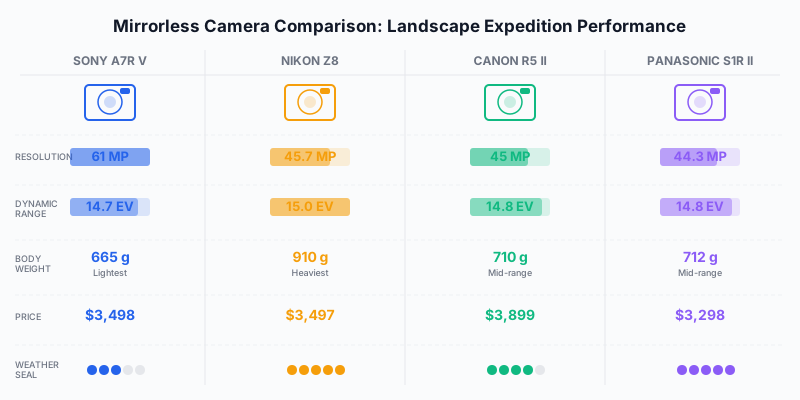
These four cameras represent the core of what most serious landscape photographers should be considering. They deliver exceptional image quality, proven reliability, and the broadest lens ecosystems at price points between $3,300 and $3,900.
Resolution: How Much Do You Actually Need?
| Camera |
Sensor Resolution |
Typical RAW File |
Max Print at 300 DPI |
Pixel Pitch |
| Sony A7R V |
61 MP |
~120 MB |
30” x 20” |
3.76 um |
| Nikon Z8 |
45.7 MP |
~90 MB |
26” x 17” |
4.34 um |
| Canon R5 II |
45 MP |
~85 MB |
25” x 17” |
4.39 um |
| Panasonic S1R II |
44.3 MP |
~80 MB |
25” x 17” |
4.42 um |
The Sony A7R V leads by a significant margin with 61 megapixels. That sounds decisive, and for certain applications it genuinely is. If you sell large prints for gallery display, license images for billboard-scale reproduction, or regularly crop aggressively to recompose in post-processing, those extra 15-17 million pixels provide real, measurable value.
But resolution has costs. Each 61 MP file demands faster cards, more storage, and more processing power. On a 14-day expedition generating 500-800 images per day, the storage math adds up quickly. More importantly, higher pixel density means smaller photosites, which can theoretically reduce per-pixel signal-to-noise ratio, though Sony’s sensor engineering has largely mitigated this concern in the A7R V.
For the majority of landscape photographers, 44-46 megapixels is more than sufficient. It produces gallery-quality prints up to 26 inches on the long edge and provides ample cropping headroom. The Nikon, Canon, and Panasonic all cluster in this range with slightly larger photosites, which contributes to their strong high-ISO performance.
The Practical Question
Ask yourself: what is the largest print you have actually sold or displayed in the last two years? If the answer is under 24 inches, 44-46 MP handles your needs with margin to spare. If you regularly deliver 30-inch-plus prints or need heavy cropping flexibility, the A7R V earns its resolution advantage. And if you find yourself wanting more than 61 megapixels, the premium tier cameras below start the conversation at 100 MP.
High-Resolution Modes: A Caveat
Both the Canon R5 II and Panasonic S1R II offer in-camera multi-shot high-resolution modes. Canon’s upscaling can produce 177 MP composites; Panasonic’s pixel-shift mode generates 177 MP images. These are tripod-only features usable with static subjects, making them genuinely useful for landscape work but irrelevant for anything that moves. They do not replace native sensor resolution for handheld shooting.
Dynamic Range: Where Landscape Photography Lives or Dies
Dynamic range is arguably the most important specification for landscape photographers. The golden hour scenes we chase, the high-contrast environments we work in, the single-exposure captures we prefer over HDR brackets when conditions are fleeting: all of these depend on a sensor’s ability to hold detail across extreme tonal ranges.
| Camera |
Measured DR at Base ISO |
Base ISO |
Highlight Recovery |
Shadow Recovery |
| Sony A7R V |
~14.7 EV |
ISO 100 |
Excellent |
Excellent |
| Nikon Z8 |
~15.0 EV |
ISO 64 |
Best in class |
Best in class |
| Canon R5 II |
~14.8 EV |
ISO 100 |
Very good |
Excellent |
| Panasonic S1R II |
~14.8 EV (est.) |
ISO 100 |
Very good |
Very good |
The Nikon Z8 wins this category, and it is not a marginal victory. Its native ISO 64 provides approximately a half-stop advantage in highlight recovery over ISO 100 cameras. In practice, this means the Z8 holds sky detail in sunrise and sunset scenes where the others begin clipping. When you are shooting a high-contrast scene with deep shadows and a bright sky, that half-stop is the difference between recoverable detail and lost information.
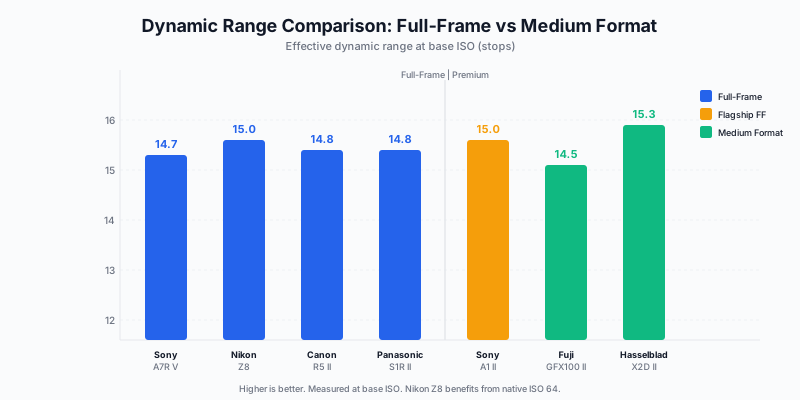
The Canon R5 II and Panasonic S1R II have both closed the gap compared to their predecessors. The R5 II’s stacked sensor delivers notably cleaner shadow recovery than the original R5, and the Panasonic S1R II posts a meaningful improvement over the original S1R’s measured 14.1 EV. Both land in the same 14.8 EV neighborhood, which is genuinely excellent.
Nikon’s color science also deserves mention. The Z8 produces RAW files that convert beautifully with minimal intervention. Skin tones, foliage greens, and sky blues have a natural quality straight from the first conversion. This does not mean the others produce poor color; they simply require more deliberate processing to achieve the same natural rendering.
Real-World Dynamic Range Test
Shoot a backlit scene with a 6-stop difference between sky highlights and foreground shadows. Push shadow recovery +4 EV in your RAW converter. The Nikon Z8 produces cleaner, more color-accurate shadow recovery than the competition. This matters when you cannot bracket because the wind is moving your foreground or the light is changing by the second.
Sony A7R V: The Resolution Specialist
Street price: ~$3,498
What It Does Best
The A7R V combines the highest resolution in the full-frame class with genuinely impressive in-body image stabilization. Sony claims 8 stops of IBIS compensation, and while real-world performance falls somewhat short of that, it remains among the best stabilization systems available. For landscape photographers who sometimes shoot handheld in low light, or who want to leave the tripod behind on a difficult scramble, this matters.
Sony’s autofocus system, powered by a dedicated processing unit, offers sophisticated subject recognition. While landscape photographers rarely need bird-eye detection, the system’s reliability in low-contrast conditions and its speed in shifting compositions are genuinely useful.
The E-mount ecosystem remains the most mature mirrorless system available. More native lenses, more third-party options, more specialty glass. If you want a tilt-shift lens, an ultra-fast wide prime, or an affordable telephoto zoom from Tamron or Sigma, E-mount has it. After more than a decade of development, the sheer breadth of choices is unmatched.
Where It Falls Short
Weather sealing has been the persistent concern with Sony’s Alpha bodies. While the A7R V represents an improvement over previous generations, field reports from expedition photographers consistently rate it behind the Nikon Z8 and Panasonic S1R II in sustained harsh conditions. If you shoot regularly in rain, salt spray, or blowing sand, this is a legitimate consideration.
Sony’s CFexpress Type A cards are more expensive and less widely available than the Type B cards used by the others. This is a minor inconvenience at home and a potential problem in remote locations.
The A7R V is also the oldest design in this comparison, launched in late 2022. While it remains a formidable camera, it lacks some of the computational photography features found in the newer Canon and Panasonic bodies. Whether that matters to you depends on whether you value proven reliability or cutting-edge features.
Nikon Z8: The Expedition Workhorse
Street price: ~$3,497
What It Does Best
The Z8 is essentially a Nikon Z9 in a smaller body, and the Z9 was designed for the most demanding professional conditions on Earth. Weather sealing is exceptional. The body inspires confidence in rain, dust, and cold in a way that few cameras in any price range can match.
Dynamic range at ISO 64 is the best available in any full-frame mirrorless camera. Period. For landscape photography, this alone justifies serious consideration. When Michael Freeman discusses the importance of tonal range in The Photographer’s Eye, he is describing exactly the kind of latitude the Z8 provides.
A CFexpress Type B and SD UHS-II dual card slot configuration provides fast write speeds and useful redundancy. On an expedition where a card failure could mean losing irreplaceable images, having two slots running in backup mode provides genuine peace of mind.
Nikon’s Z-mount lenses, while fewer in total number than Sony’s E-mount offerings, are optically extraordinary. The Z 14-24mm f/2.8 S is widely considered the finest ultra-wide zoom ever manufactured. The Z 24-70mm f/2.8 S and Z 70-200mm f/2.8 VR S complete a holy trinity that rivals or exceeds any equivalent set from any manufacturer. Third-party support from Tamron and Sigma has expanded significantly through 2025, closing the ecosystem gap.
Where It Falls Short
The Z8 is the heaviest body in the full-frame tier at 910 grams. On multi-day treks where every gram matters, this weight penalty is real. With a Z 14-24mm f/2.8 S attached, the combined weight reaches 1,650 grams, noticeably heavier than equivalent kits from the other three systems.
Battery life, rated at 340 shots by CIPA standards, is the second-lowest here. In practice, real-world performance typically exceeds the conservative CIPA rating by a meaningful margin, but it still trails the Sony in extended shooting sessions.
Canon EOS R5 II: The Versatile Professional
Street price: ~$3,899
What It Does Best
The R5 II is the most versatile camera in the full-frame tier. Its hybrid photo and video capability is genuinely best-in-class, with 8K 60p RAW internal recording and dramatically improved thermal management over the original R5. For photographers who also produce video content, tutorials, or behind-the-scenes footage, the R5 II does double duty more effectively than any competitor.
Canon’s stacked CMOS sensor, new for the Mark II, delivers 30 fps electronic shutter with minimal rolling shutter distortion. While landscape photographers rarely need 30 fps, the underlying sensor technology translates to faster readout, reduced banding, and improved flash sync: benefits that matter in the field even at slower frame rates.
The IBIS system is rated at 8.5 stops with compatible lenses, the highest stabilization claim in this group. Canon’s Dual Pixel autofocus remains outstanding for accuracy, and the R5 II introduces eye-controlled AF, which lets you select focus points by looking at them through the viewfinder. It sounds like a gimmick until you use it while recomposing on a windswept ridge with gloves on.
Where It Falls Short
The R5 II carries the highest street price in the full-frame tier at ~$3,899, roughly $400 more than the Sony and Nikon. For a body that resolves less than the Sony and has slightly less dynamic range than the Nikon, the premium is hard to justify purely on landscape photography merits. You are paying for video capability and the stacked sensor’s speed benefits.
Canon’s RF mount licensing restrictions have historically limited third-party lens availability. While Tamron and Sigma have begun releasing RF-mount lenses, the selection still trails what is available for E-mount and Z-mount. This gap is closing but has not closed.
Dual card slots are a CFexpress Type B plus SD UHS-II configuration, the same arrangement found on the Nikon Z8 and Panasonic S1R II. Backup writing speeds are limited by the slower SD card.
Panasonic Lumix S1R II: The Value Contender
Street price: ~$3,298
What It Does Best
The S1R II is the story of 2025 in landscape camera gear. Panasonic took everything that made the original S1R a cult favorite among landscape photographers, addressed its weaknesses, and priced the result aggressively enough to force a conversation.
At 44.3 megapixels with an estimated 14.8 EV of dynamic range, the S1R II’s imaging performance places it squarely alongside the Canon R5 II. But at $3,298, it undercuts every camera in the full-frame tier by $200 to $600. For photographers on a budget who still want flagship-tier image quality, this math is hard to argue with.
Weather sealing is genuinely excellent. Panasonic inherited the S1R’s reputation for surviving conditions that other cameras cannot, with splash, dust, and freeze resistance rated down to -10C. Field reports from landscape shooters in coastal and winter conditions have been consistently positive.
The IBIS system delivers 8 stops of compensation, and the S1R II adds a new cropless electronic image stabilization mode for video that does not affect field of view. The 177 MP pixel-shift high-resolution mode is the highest-resolution multi-shot capability in this group.
Where It Falls Short
Autofocus, despite the massive improvement, still does not match Sony, Nikon, or Canon in tracking reliability. For landscape photography this matters less than for wildlife or sports, but if you also shoot moving subjects, the S1R II is the weakest performer in this group at subject tracking.
The L-mount ecosystem is the smallest of the four systems. While Sigma and Leica also produce L-mount lenses, the total selection is significantly smaller than E-mount, Z-mount, or RF mount. The available glass is generally good to excellent, but your options are more limited, particularly for specialized focal lengths.
Battery life is the lowest in this comparison at 350 shots (LCD) or 280 shots (EVF). On multi-day expeditions, plan to carry more spare batteries than you would with the other three cameras.
| Camera |
CIPA Rating (20C) |
Estimated at -10C |
Estimated at -20C |
| Sony A7R V |
530 shots |
~300 shots |
~180 shots |
| Nikon Z8 |
340 shots |
~220 shots |
~140 shots |
| Canon R5 II |
490 shots |
~290 shots |
~170 shots |
| Panasonic S1R II |
350 shots |
~210 shots |
~130 shots |
Field strategies for cold weather:
- Carry spare batteries in an inside pocket against your body
- Rotate batteries between camera and pocket every 45 minutes
- Use a battery grip to double capacity (adds weight)
- Consider an external USB power bank for extended timelapses
- Warm camera slowly when returning indoors to prevent internal condensation
Lens Ecosystem Analysis
Sony E-Mount
- Breadth: Largest selection of native and third-party autofocus lenses
- Standout for landscape: Sony FE 14mm f/1.8 GM (astrophotography and northern lights)
- Budget-friendly options: Tamron 17-28mm f/2.8, Sigma 24-70mm f/2.8 Art
- Maturity: 12+ years of development, deepest third-party support
Nikon Z-Mount
- Quality: Arguably the highest average optical quality of any current mount
- Standout for landscape: Nikkor Z 14-24mm f/2.8 S (best ultra-wide zoom made)
- Growing third-party: Tamron and Sigma now releasing Z-mount lenses at increasing pace
- Trajectory: Rapidly expanding, quality over quantity
Canon RF Mount
- Professional focus: Strong zoom lineup with excellent L-series primes
- Standout for landscape: RF 15-35mm f/2.8 L IS USM (with stabilization)
- Third-party progress: Tamron and Sigma entering RF mount, but selection still limited
- Unique options: RF 100-500mm f/4.5-7.1 L IS USM for landscape-wildlife versatility
Panasonic L-Mount
- Alliance advantage: Shared mount with Sigma and Leica lenses
- Standout for landscape: Sigma 14-24mm f/2.8 DG DN Art (excellent and affordable)
- Budget-friendly: Sigma Art lenses available natively without adaptation
- Limitation: Smallest total selection; fewer specialty options
Weight Considerations for Multi-Day Treks
| Kit Configuration |
Sony A7R V |
Nikon Z8 |
Canon R5 II |
Panasonic S1R II |
| Body only |
665g |
910g |
710g |
712g |
| + Ultra-wide zoom |
1,485g |
1,660g |
1,540g |
1,517g |
| + Standard zoom |
1,555g |
1,610g |
1,590g |
1,542g |
| + 2 extra batteries |
1,699g |
1,770g |
1,734g |
1,686g |
| + Filters and accessories |
~2,100g |
~2,200g |
~2,150g |
~2,100g |
Over a 10-day trek covering 15-20 km daily, a 200-gram difference in base kit weight is noticeable. The Sony A7R V’s weight advantage is its most underappreciated feature for expedition photographers.
Dual Card Slot Strategy
| Camera |
Slot 1 |
Slot 2 |
Recommended Configuration |
| Sony A7R V |
CFexpress Type A |
SD UHS-II |
Overflow or RAW+JPEG split |
| Nikon Z8 |
CFexpress Type B |
SD UHS-II |
Overflow or RAW+JPEG split |
| Canon R5 II |
CFexpress Type B |
SD UHS-II |
Overflow or RAW+JPEG split |
| Panasonic S1R II |
CFexpress Type B |
SD UHS-II |
Overflow or RAW+JPEG split |
All four cameras offer dual card slots for data redundancy. The Nikon Z8’s CFexpress Type B primary slot provides fast write speeds, with the SD UHS-II secondary slot available for overflow or backup.
Full-Frame Verdict: Matching Camera to Photographer
Choose the Sony A7R V if:
- Maximum full-frame resolution is a genuine need (large prints, heavy cropping)
- You prioritize body weight for long treks
- You want the deepest lens ecosystem with the most third-party options
- You are already invested in Sony E-mount glass
Choose the Nikon Z8 if:
- Dynamic range is your primary technical priority
- You work frequently in harsh weather: rain, cold, dust, salt spray
- Data security through dual card slots matters
- You value natural color rendition with minimal processing
Choose the Canon R5 II if:
- You need strong hybrid photo and video capability
- Eye-controlled AF and 30 fps shooting add value for your work
- You are invested in Canon RF glass
- Versatility across photography genres matters more than peak landscape performance
Choose the Panasonic S1R II if:
- Value is a priority without sacrificing image quality
- You want excellent weather sealing at a lower price than the Nikon
- You are comfortable with a smaller lens ecosystem through the L-mount alliance
- The 177 MP pixel-shift mode is relevant to your tripod-based workflow
Now we enter different territory entirely. The cameras in this section cost roughly twice what the full-frame workhorses command, and the question shifts from “which camera is best?” to “does the investment justify the returns?”
For photographers who sell large gallery prints, license high-resolution files commercially, or simply demand the absolute best tonal quality available in a portable system, these three cameras represent the current state of the art.
Before examining individual cameras, it is worth understanding what medium format actually delivers and why landscape photographers in particular benefit from larger sensors.
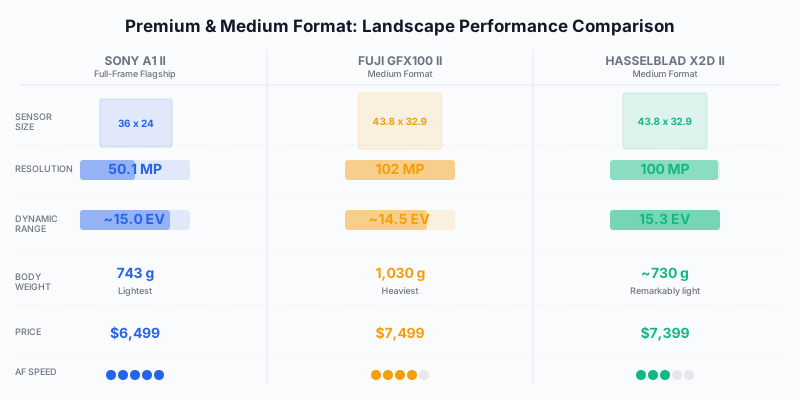
The medium format sensors in the Fuji GFX and Hasselblad X systems measure 43.8 x 32.9mm, roughly 1.7 times the area of a 36 x 24mm full-frame sensor. That additional sensor real estate translates to several measurable advantages:
Tonal depth and gradation. Larger photosites capture more photons per pixel, which produces smoother transitions between tones. In a landscape photograph, this manifests as more natural-looking skies, smoother water gradients, and richer shadow detail. The difference is subtle on a phone screen and unmistakable in a 40-inch gallery print. As Bruce Barnbaum discusses in The Art of Photography, the way light transitions across a frame is as important as the light itself. Medium format captures those transitions with a fidelity that full-frame sensors cannot quite match.
Higher native resolution. Both the Fuji GFX100 II and Hasselblad X2D II deliver 100+ megapixels natively, without computational multi-shot compositing. This is genuine optical resolution: every pixel represents a single captured moment, usable at any shutter speed, including handheld shooting.
Dynamic range ceiling. The Hasselblad X2D II 100C claims 15.3 stops of dynamic range at its native ISO 50, which places it at or above the best full-frame sensors. Larger photosites with deeper electron wells simply collect more data before clipping.
Shallower depth of field at equivalent apertures. For a given field of view and aperture, medium format produces slightly shallower depth of field than full-frame. In landscape photography, this is less relevant than in portraiture, but it provides a dimensional quality to foreground elements that experienced viewers notice.
Medium format comes with real tradeoffs that you should weigh honestly:
- Autofocus speed: Even the best medium format AF systems (the Fuji GFX100 II) trail full-frame flagships by a meaningful margin. If your landscape work involves fleeting moments, fast-moving weather, or wildlife in the frame, this gap matters.
- Lens selection: Medium format ecosystems offer far fewer lens options than Sony E-mount or Nikon Z-mount. You will have excellent standard zooms and primes, but specialty lenses, ultra-fast apertures, and budget third-party options are limited.
- Weight and bulk: A medium format kit with two lenses, filters, and accessories can easily exceed 3 kg, compared to 2-2.2 kg for a comparable full-frame setup.
- Cost: Bodies alone range from $5,000 to $7,500. Adding two or three lenses pushes a complete system to $12,000-$20,000.
- Buffer and workflow: 100 MP files at 16-bit demand serious storage, processing power, and patience. Expect 150-200 MB per RAW file.
The honest assessment: if you are primarily a landscape photographer who sells large prints or licenses high-resolution files, and your shooting style is deliberate rather than reactive, medium format delivers a visible quality advantage. If you need speed, versatility, or affordability, the full-frame tier serves you better.
Sony Alpha 1 II: The Do-Everything Flagship
Street price: ~$6,499 | Sensor: 50.1 MP full-frame stacked CMOS | Weight: 743g body only
What It Does Best
The Alpha 1 II is not a medium format camera. It is included in this premium tier because it represents the absolute pinnacle of full-frame technology, and many photographers considering medium format should evaluate it first.
At 50.1 megapixels on a stacked BSI CMOS sensor, the A1 II sits in a resolution sweet spot: enough pixels for large prints and significant cropping, without the storage burden of 100 MP files. The stacked architecture enables 30 fps burst shooting with full autofocus tracking, 8K 30p video, and a readout speed that virtually eliminates rolling shutter. None of the medium format cameras can match this speed.
The autofocus system is the best in any camera at any price. A dedicated processing unit enables real-time subject recognition across seven categories, with human and animal eye detection improved by 30-50% over the original A1. For landscape photographers who also shoot wildlife, travel portraits, or documentary work, no other camera in this comparison offers the same breadth of capability.
Sony’s 8.5-stop IBIS system delivers stabilization that makes 1-2 second handheld exposures genuinely achievable in the field. The 9.44-million-dot EVF is the highest-resolution viewfinder on any camera, period.
Dynamic range is excellent, measuring approximately 15 stops at base ISO 100. This places it in the same territory as the Nikon Z8 and within striking distance of the Hasselblad. Shadow recovery is clean and color-accurate through +4 EV of push.
Where It Falls Short
At $6,499, the A1 II costs nearly double the Nikon Z8 while delivering fewer megapixels and no medium format tonal advantage. The price is justified by the stacked sensor’s speed, the autofocus system, and the video capabilities, but if your primary use is tripod-based landscape photography, you are paying for features you may rarely use.
The A1 II shares Sony’s E-mount weather sealing limitations. It is improved over the A7R series, but field reports still rate it below the Nikon Z8 for sustained exposure to rain and spray.
Resolution sits below the medium format cameras by a factor of two. If your workflow demands the absolute maximum detail capture, 50 megapixels may leave you wanting, especially if you crop frequently.
The A1 II Landscape Argument
The case for the A1 II over medium format is versatility. This is the camera for the photographer who shoots landscapes at dawn, wildlife at midday, and documentary portraits at golden hour. No medium format system can match that range. If you own one camera body for everything, the A1 II is the strongest argument against medium format that exists.
Street price: ~$7,499 | Sensor: 102 MP medium format (43.8 x 32.9mm) | Weight: 1,030g body only
What It Does Best
The GFX100 II is the most capable medium format camera ever built for active field work. Its autofocus system, powered by deep-learning subject detection, represents a generational leap that finally makes medium format viable for subjects beyond static landscapes. It can track moving subjects, detect eyes, and maintain focus during recomposition in a way that previous medium format cameras simply could not.
102 megapixels of native resolution delivers files that can be printed at 40 inches or larger with extraordinary detail. The sensor’s 400 MP pixel-shift mode pushes this further for tripod work with static subjects, producing files with almost no false color artifacts.
Fujifilm’s color science is legendary for a reason. The GFX100 II’s RAW files convert with a richness and tonal subtlety that rewards careful processing. The Film Simulation modes, particularly Velvia and Classic Chrome, provide starting points that experienced photographers genuinely appreciate rather than treat as gimmicks.
At 8 fps continuous shooting, this is the fastest medium format camera available. Combined with the autofocus improvements, it opens medium format to documentary and travel work that was previously the exclusive domain of full-frame systems.
8-stop IBIS makes handheld medium format shooting practical in conditions where previous generations demanded a tripod. Dynamic range measures approximately 14.5 stops at the base ISO of 80, which is excellent though slightly below the Hasselblad’s claimed 15.3 stops.
Where It Falls Short
Weight is the defining compromise. At 1,030 grams body only, the GFX100 II is nearly 100 grams heavier than the already-heavy Nikon Z8. Add the GF 32-64mm f/4 R LM WR standard zoom (875g) and you are carrying nearly 2 kg before batteries and filters. On multi-day treks, this weight compounds.
The GFX lens ecosystem, while growing, remains limited compared to full-frame systems. Fujifilm offers approximately 15 GF-mount lenses covering focal lengths from the equivalent of 16mm to 180mm (in full-frame terms). Quality is generally excellent, but you have fewer choices at each focal length, no ultra-fast primes beyond f/1.7, and no third-party autofocus alternatives.
Weather sealing is rated for dust and moisture resistance, but field reports place it behind the Nikon Z8 and Sony A1 II for sustained harsh conditions. This is not a camera you should feel entirely confident using in steady rain without protection.
The EVF, while improved, does not match the A1 II’s 9.44-million-dot panel for resolution and clarity.
Fujifilm also offers the GFX100S II at $4,999, which shares the same 102 MP sensor in a lighter body (883g). It sacrifices the GFX100 II’s 8 fps burst (dropping to 7 fps), video capabilities, and some autofocus refinements, but delivers identical image quality at a significantly lower price. For landscape photographers who shoot primarily from a tripod and do not need the speed advantages, the GFX100S II is a compelling entry point to medium format. At barely $1,500 more than a Canon R5 II, it offers a genuine resolution and tonal quality upgrade.
Hasselblad X2D II 100C: The Image Quality Purist
Street price: ~$7,399 | Sensor: 100 MP BSI CMOS medium format (43.8 x 32.9mm) | Weight: ~840g body only
What It Does Best
The X2D II 100C exists to produce the finest image quality available in a handheld camera system. Everything about its design serves that singular purpose.
The 100 MP BSI CMOS sensor delivers 15.3 stops of measured dynamic range at a native ISO of 50, the highest dynamic range of any camera in this entire comparison. In landscape photography, where you are constantly managing the tonal range between bright skies and dark foregrounds, this sensor latitude is transformative. Single exposures capture usable detail from deep shadows to bright highlights that would require bracketed HDR on lesser sensors.
16-bit color depth produces approximately 281 trillion colors, compared to the 14-bit output of most full-frame cameras. In practical terms, this translates to smoother gradient rendering in skies, water, and atmospheric haze. The difference is particularly visible in large prints where banding artifacts in blue skies or sunset gradients can undermine an otherwise strong image.
The 5-axis, 10-stop IBIS system is the most effective stabilization in any medium format camera. Hasselblad claims up to 8 times the stability of the original X2D when shooting distant subjects, enabling handheld exposures of several seconds in controlled conditions. For landscape photographers who want to work without a tripod during blue hour or in deep forest shade, this changes what is possible.
The X2D II introduces continuous autofocus supported by LiDAR distance sensors, a significant upgrade from the contrast-detect AF of the original X2D. The 425 PDAF points spread across the sensor provide faster, more reliable focusing than its predecessor.
At approximately 840 grams body-only, the X2D II is remarkably light for a medium format camera, roughly 100 grams heavier than the Sony A1 II and 130 grams heavier than the Canon R5 II. For a 100 MP medium format body, this weight is impressive.
Where It Falls Short
Autofocus, despite the LiDAR-assisted upgrade, remains the X2D II’s Achilles heel relative to the competition. It is vastly improved over the original X2D, but it still cannot track moving subjects with the confidence or speed of the Fuji GFX100 II, let alone the Sony A1 II. For static landscape subjects, it is perfectly adequate. For anything that moves unpredictably, it will frustrate you.
The XCD lens ecosystem covers focal ranges from 20mm to 230mm (equivalent), but the total selection remains small: approximately 15 lenses. There are no third-party alternatives. Lens leaf shutters enable flash sync at all speeds, which is a niche advantage, but the lack of variety is a genuine limitation for photographers who want specialized optics.
Maximum burst speed is approximately 3.3 fps, the slowest in this entire comparison by a wide margin. This is a camera for deliberate, considered photography. If you need to fire rapidly at a fleeting moment of light, the X2D II’s buffer and write speed will constrain you.
The built-in 1 TB SSD is a thoughtful inclusion for storage, but it cannot replace removable cards for backup redundancy on expedition. The single CFexpress Type B slot provides the primary removable storage.
The Hasselblad Intangible
There is a quality to Hasselblad files that resists specification sheets. Photographers who have printed both full-frame and Hasselblad medium format files side by side at 30+ inches consistently describe a “presence” or “dimensionality” in the Hasselblad output. Part of this is measurable: higher color bit depth, wider dynamic range, smoother tonal gradients. Part of it may be the optical quality of XCD lenses, which are designed specifically for the sensor. Whatever the cause, the X2D II produces files that reward large-format printing in a way that no full-frame camera can fully replicate.
Premium Tier: Head-to-Head Comparison
| Specification |
Sony A1 II |
Fuji GFX100 II |
Hasselblad X2D II 100C |
| Sensor format |
Full-frame (36x24) |
Medium (43.8x32.9) |
Medium (43.8x32.9) |
| Resolution |
50.1 MP |
102 MP |
100 MP |
| Dynamic range |
~15.0 EV |
~14.5 EV |
15.3 EV |
| Base ISO |
100 |
80 |
50 |
| IBIS |
8.5 stops |
8 stops |
10 stops |
| Burst rate |
30 fps |
8 fps |
3.3 fps |
| Body weight |
743g |
1,030g |
~840g |
| AF points |
759 |
Phase detect AI |
425 PDAF + LiDAR |
| Color depth |
14-bit |
16-bit |
16-bit |
| RAW file size |
~100 MB |
~200 MB |
~200 MB |
| Price (body) |
$6,499 |
$7,499 |
$7,399 |
| Pixel-shift max |
– |
400 MP |
– |
| Video max |
8K 30p |
8K 30p |
4K 30p |
A Note on Phase One
For the sake of completeness: Phase One systems with IQ4 150 MP digital backs represent the absolute ceiling of portable image quality, with 150 megapixels on a full 44 x 33mm sensor, Rodenstock optics with shift movements, and Capture One integration that is unmatched. They also cost $50,000-$65,000 for a complete system, weigh significantly more, and have no autofocus in the traditional sense. Phase One occupies a different universe from even the Hasselblad and Fuji systems discussed here. If your work generates the revenue to justify the investment and you shoot primarily from a tripod with deliberate composition, Phase One delivers results that nothing else can match. For the vast majority of landscape photographers, including serious professionals, the cameras discussed above provide 95% of Phase One’s image quality at a fraction of the cost and with vastly greater field practicality.
What About the Sony A7R VI and Nikon Z9 II?
If you have been following camera rumors, you know that both Sony and Nikon are expected to release next-generation flagships. The Sony A7R VI is rumored to feature an 80 MP stacked sensor with the new BIONZ XR2 processor. The Nikon Z9 II is expected to bring an upgraded EXPEED 8 processor with enhanced video capabilities.
Neither camera has been officially announced. Neither has a confirmed release date, though speculation points to late 2026 for both. Here is the critical question: should you wait?
If you need a camera for expeditions you are planning in 2026, the answer is no. The cameras available today are not compromised placeholders waiting to be replaced. They are mature, proven tools that produce extraordinary results. Every month you spend waiting for a rumored camera is a month of missed photographs. The best time to buy a camera is when you need one.
Exercises: Know Your Camera Before the Expedition
1. The Dynamic Range Stress Test
Find a high-contrast scene with at least 5 stops between highlights and shadows. Shoot a single exposure biased toward the highlights. In your RAW converter, push shadow recovery to +4 EV and evaluate noise, color accuracy, and banding. This reveals your camera’s true latitude better than any spec sheet.
2. The Cold Battery Drill
Place your camera and one spare battery in the refrigerator for two hours (approximately 3-5C). Shoot continuously and note when the battery indicator drops each bar. Repeat at room temperature. The difference tells you exactly how many extra batteries to pack for cold-weather expeditions.
3. The Weather Seal Confidence Test
On a rainy day, take your camera out and shoot for 30 minutes in moderate rain. Wipe it down and inspect every port and seal. Then do it again. You need to know your camera’s weather limits before you are on a mountaintop with no shelter, not after.
4. The Card Failure Recovery
Fill a memory card with test images. Safely eject it, then use recovery software (PhotoRec or similar) to recover the images. Knowing how to recover data from a corrupted card before it happens reduces panic in the field.
5. The Blind Settings Drill
Wear thick winter gloves. Without looking at the screen, change your ISO from 100 to 400, switch from single-shot to continuous AF, adjust exposure compensation to -1.3, and switch to back-button focus. Time yourself. Repeat until you can do it in under 15 seconds. On an expedition, you will need to make these changes with numb fingers in fading light.
The Honest Bottom Line
The professional full-frame tier offers four cameras that exceed what flagship DSLRs delivered just five years ago. For most landscape photographers, including working professionals, one of these four bodies paired with strong glass will never be the limiting factor. The Sony A7R V wins on resolution and weight. The Nikon Z8 wins on dynamic range and weather sealing. The Canon R5 II wins on versatility. The Panasonic S1R II wins on value.
The premium tier exists for photographers who want more and are willing to pay for it. The Sony A1 II is for the photographer who wants one body that does everything at the highest level, speed and quality without compromise. The Fujifilm GFX100 II is for the active expedition photographer who wants medium format quality without surrendering autofocus capability and burst speed. The Hasselblad X2D II 100C is for the image quality purist who prioritizes tonal depth, dynamic range, and the finest possible file quality above all else, and is comfortable with a more deliberate shooting style.
If I were equipping myself for a year of expedition landscape work with no existing lens investment and no budget ceiling, I would carry a Nikon Z8 as my primary workhorse for its combination of dynamic range, weather sealing, and optical quality, and a Hasselblad X2D II for the hero compositions where tonal perfection and maximum resolution justify the deliberate approach. That two-body combination covers the full spectrum of expedition needs.
But the most important truth remains unchanged: your vision, your patience with weather and light, your willingness to hike that extra ridge, these matter infinitely more than the sensor behind the lens. Choose the camera you trust completely when the light appears. Then stop thinking about gear and start thinking about photographs.