Owning a Drone vs. Making Aerial Photographs
Owning a drone makes you a drone pilot. Making compelling aerial photographs makes you an aerial photographer. The distinction matters because it clarifies what you should actually care about when choosing a drone for landscape work: not flight tricks, not obstacle avoidance sensor counts, not video frame rates, but image quality, dynamic range, and the ability to produce files that can survive professional post-processing and hold up as large prints.
The consumer drone market overwhelms buyers with feature comparisons that prioritize videography, autonomous flight modes, and safety systems. Those features matter, but they are secondary to the question a landscape photographer should ask first: can this sensor produce files that match the quality standard of my ground-based work?
This guide evaluates DJI’s current lineup through that lens. The 2025-2026 generation of drones, led by the Mavic 4 Pro and the Air 3S, represents the most significant sensor upgrade cycle since the original Mavic 3 launched with its Hasselblad 4/3-inch sensor. Four drones, four price points, and one honest assessment of which one belongs in your kit.
What Makes a Drone Suitable for Professional Landscape Work
Before comparing specific models, establish the baseline requirements:
Sensor quality and dynamic range: The sensor must produce files with enough latitude for significant highlight recovery and shadow lifting. Landscape photography involves high-contrast scenes (bright skies, dark foregrounds), and a drone sensor that clips highlights or crushes shadows limits your post-processing options. The Mavic 4 Pro’s 16-stop dynamic range now puts drone sensors within striking distance of dedicated ground-based cameras.
RAW capability: JPEG output from drone cameras is heavily processed and compressed. RAW files (DNG format on DJI drones) preserve the full tonal range the sensor captures. For professional landscape work, RAW is non-negotiable. The shift from 12-bit to 14-bit RAW on the Mavic 4 Pro is a meaningful improvement for photographers who push shadow recovery and tonal editing.
Flight stability: Long exposure drone photography requires rock-solid hovering. GPS lock, gimbal stabilization, and wind resistance all contribute. A drone that drifts or vibrates in moderate wind produces soft images.
Battery life: Landscape photography requires time. You need to reach your altitude, compose thoughtfully, wait for light changes, and shoot multiple exposures. The Mavic 4 Pro’s 51-minute flight time gives you genuine room to work.
Portability: Landscape photographers hike. Every gram matters when you are carrying a camera body, multiple lenses, a tripod, filters, and now a drone with batteries. The drone must earn its weight in your pack.
The Four Contenders
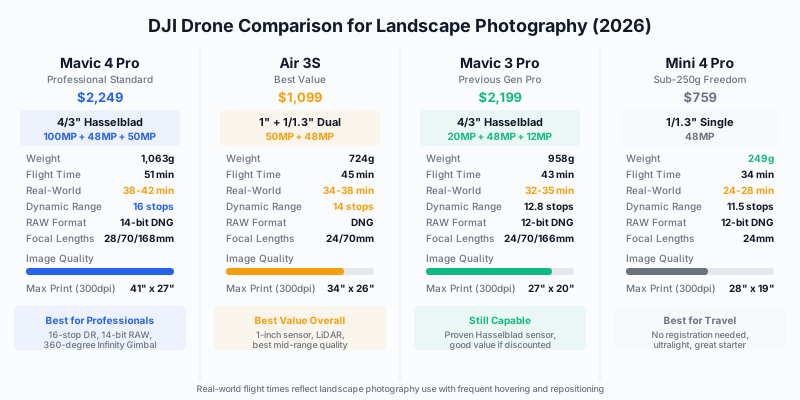
DJI Mavic 4 Pro: The New Professional Standard
Price: $2,249 (Fly More Combo: $3,200 | Creator Combo: ~$4,500)
The Mavic 4 Pro is the most capable camera drone ever made for landscape photography. That is not marketing language; it is a statement of measurable fact. Every specification that matters for still photography has improved over the Mavic 3 Pro, and several improvements are substantial rather than incremental.
Sensor and Image Quality
The Mavic 4 Pro’s primary camera uses an upgraded 4/3-inch Hasselblad-branded sensor in a new 3:2 aspect ratio (the Mavic 3 Pro used 4:3). The quad-Bayer design produces native 25-megapixel images with the option to output 100-megapixel pixel-shifted captures in good light.
Dynamic range: 16 stops. This number deserves emphasis because it represents a generational leap. The Mavic 3 Pro delivered approximately 12.8 stops. The Mavic 4 Pro’s 16 stops approach what full-frame mirrorless cameras achieve. For landscape photographers who shoot high-contrast sunrise and sunset scenes, this means fewer situations where bracketing is mandatory. Many scenes that previously required a 3 or 5-bracket AEB sequence can now be captured in a single exposure with enough latitude for shadow and highlight recovery.
14-bit RAW: The move from 12-bit to 14-bit DNG is significant for post-processing. A 14-bit file contains 16,384 tonal levels per channel compared to 4,096 in a 12-bit file. The practical result is smoother gradations, less banding in skies during heavy edits, and more latitude when pushing shadow recovery. If you process drone images aggressively, you will see the difference.
High-ISO performance: The Mavic 4 Pro introduces Dual Native ISO Fusion across all three cameras. The practical impact is most visible from ISO 800 and above, where the Mavic 4 Pro produces noticeably cleaner files than the Mavic 3 Pro at equivalent sensitivities. For golden hour and blue hour aerial work where some ISO elevation is unavoidable, this matters.
Color science: The Hasselblad Natural Color Solution (HNCS) continues to produce the most natural color rendition in any consumer drone. The 3:2 aspect ratio of the new sensor also means less cropping waste when preparing images for standard print ratios.
The Infinity Gimbal
The Mavic 4 Pro’s Infinity Gimbal delivers full 360-degree rotation with 70-degree upward tilt capability. For landscape photography, this means:
- True vertical/portrait orientation shooting without cropping from a landscape frame
- Uninterrupted panning shots during composition exploration without repositioning the aircraft
- Upward-looking shots of cliff faces, arches, and overhanging terrain that were previously impossible
This is not a gimmick. The ability to shoot portrait orientation at full resolution opens compositional options that every previous consumer drone locked you out of.
The Triple Camera System
| Camera |
Sensor |
Resolution |
Equivalent FL |
Aperture |
Best Use |
| Main (Hasselblad) |
4/3” |
25MP (100MP mode) |
28mm |
f/2.0-f/11 |
Primary landscape work |
| Medium Tele |
1/1.3” |
48MP |
70mm |
f/2.8 |
Compressed perspectives, details |
| Long Telephoto |
1/1.5” |
50MP |
168mm |
f/2.8 |
Distant subjects, wildlife |
The main camera’s variable aperture of f/2.0 to f/11 is a meaningful upgrade from the Mavic 3 Pro’s f/2.8 to f/11. The wider f/2.0 aperture gathers more light at the wide end, which improves performance in golden hour and low-light conditions. At f/5.6 to f/8, the lens delivers peak sharpness for landscape work.
The 70mm medium telephoto remains the most useful secondary camera. The long telephoto has been upgraded from a 12MP 1/2-inch sensor to a 50MP 1/1.5-inch sensor, a meaningful improvement that makes the third camera genuinely usable for serious work rather than just scouting.
Specifications Summary
| Specification |
Detail |
| Weight |
1,063g |
| Max Flight Time |
51 minutes (rated) / 38-42 minutes (real-world) |
| Max Speed |
56 mph (90 km/h) |
| Wind Resistance |
Level 6 (24-30 mph) |
| RAW Format |
14-bit DNG |
| Max Photo Resolution |
100MP (main, quad-Bayer) / 48MP (medium) / 50MP (tele) |
| Obstacle Sensing |
Omnidirectional (6 fisheye sensors) |
| Transmission Range |
30 km (O4+) |
| Internal Storage |
64GB (512GB in Creator Combo) |
Who Should Buy the Mavic 4 Pro
- Professional landscape photographers who sell prints, license images, or deliver to clients
- Photographers who shoot in challenging light where dynamic range is critical
- Anyone who prints aerial work at gallery scale (30 inches and above)
- Photographers upgrading from the Mavic 3 Pro who want 14-bit RAW and substantially more dynamic range
DJI Air 3S: The New Best Value
Price: $1,099 (Fly More Combo: ~$1,549)
The Air 3S replaced the Air 3 in late 2024 and represents the biggest generational improvement in the Air series to date. The headline change: a 1-inch primary sensor that puts the Air 3S closer to the Mavic line’s image quality than any Air drone before it.
Sensor and Image Quality
The Air 3S carries a 1-inch CMOS primary camera at 50 megapixels alongside a 1/1.3-inch medium telephoto at 48 megapixels. The 1-inch primary sensor is a substantial upgrade from the Air 3’s 1/1.3-inch sensor.
Dynamic range: 14 stops. This is a significant leap from the Air 3’s approximately 11.9 stops and places the Air 3S’s primary camera in the same territory as many APS-C cameras. For landscape photographers, 14 stops is genuinely sufficient for the majority of high-contrast scenes. You will still want to bracket for extreme sunrise/sunset situations, but overcast days, midday shooting, and moderate-contrast golden hour scenes can be captured in a single exposure.
Resolution: The 50MP primary sensor produces higher-resolution files than the Mavic 4 Pro’s native 25MP output (though the Mavic 4 Pro’s 100MP quad-Bayer mode exceeds it). For subjects with fine detail — agricultural textures, urban patterns, forest canopy — this resolution advantage is real.
LiDAR obstacle sensing: The Air 3S is the first DJI consumer drone with forward-facing LiDAR, which dramatically improves obstacle detection in low-light and nighttime conditions. For photographers who fly during blue hour or pre-dawn, this is a genuine safety improvement.
Dual Camera System
| Camera |
Sensor |
Resolution |
Equivalent FL |
Aperture |
| Wide |
1” CMOS |
50MP |
24mm |
f/1.8 |
| Medium Tele |
1/1.3” |
48MP |
70mm |
f/2.8 |
The f/1.8 aperture on the primary camera is faster than the Mavic 4 Pro’s primary lens at f/2.0, which gives the Air 3S a slight edge in low-light single-exposure situations where you cannot open the aperture further.
Specifications Summary
| Specification |
Detail |
| Weight |
724g |
| Max Flight Time |
45 minutes (rated) / 34-38 minutes (real-world) |
| Wind Resistance |
Level 5 (19-24 mph) |
| RAW Format |
DNG |
| Max Photo Resolution |
50MP (wide) / 48MP (tele) |
| Obstacle Sensing |
Omnidirectional with forward LiDAR |
| Transmission Range |
20 km (FCC) |
| Internal Storage |
42GB |
Who Should Buy the Air 3S
- Serious enthusiasts and semi-professionals who want a 1-inch sensor at a mid-range price
- Travel photographers who need a balance of sensor quality and portability
- Photographers upgrading from the Air 3 who want a meaningful sensor improvement
- Anyone who flies frequently in low-light conditions and values the LiDAR safety net
DJI Mavic 3 Pro: The Previous Generation Professional
Price: ~$2,199 (may be discounted as inventory clears)
The Mavic 3 Pro was the professional standard from 2023 through mid-2025. It remains a capable drone, and photographers who already own one should not feel compelled to upgrade unless 14-bit RAW and the dynamic range improvement specifically address limitations in their work.
Why It Still Matters
The Mavic 3 Pro’s 4/3-inch Hasselblad sensor at 20 megapixels still produces excellent files. The 12.8 stops of dynamic range, while surpassed by the Mavic 4 Pro, remains more than adequate for the majority of landscape scenarios. The Hasselblad color science is identical in character.
For photographers on a budget, a discounted Mavic 3 Pro represents a strong value proposition. The image quality gap between the Mavic 3 Pro and the Mavic 4 Pro, while real, is not as dramatic as the gap between either of them and the Air or Mini series.
Where It Falls Behind
- 12-bit RAW vs. 14-bit RAW: The Mavic 4 Pro’s 14-bit files provide four times the tonal depth. Visible in aggressive shadow recovery and sky gradation editing.
- 12.8 stops vs. 16 stops: The dynamic range difference is measurable and occasionally decisive in high-contrast scenes.
- No Infinity Gimbal: The Mavic 3 Pro’s gimbal cannot rotate 360 degrees or tilt upward.
- Shorter flight time: 43 minutes rated vs. 51 minutes. In real-world landscape use, that is roughly 32-35 vs. 38-42 minutes.
- Slower obstacle avoidance: The Mavic 4 Pro’s six fisheye sensors operate at higher speeds in darkness.
Specifications Summary
| Specification |
Detail |
| Weight |
958g |
| Max Flight Time |
43 minutes (rated) / 32-35 minutes (real-world) |
| Wind Resistance |
Level 6 (24-30 mph) |
| RAW Format |
12-bit DNG |
| Max Photo Resolution |
20MP (main) / 48MP (medium) / 12MP (tele) |
| Obstacle Sensing |
Omnidirectional (APAS 5.0) |
| Transmission Range |
15 km (O3+) |
Who Should Keep or Buy the Mavic 3 Pro
- Photographers who already own it and are satisfied with their file quality
- Budget-conscious professionals who find it at a significant discount
- Videographers who prioritize the proven ProRes workflow (the Mavic 3 Pro Cine variant)
DJI Mini 4 Pro: Sub-250g Freedom
Price: $759 (Fly More Combo: $1,099)
The Sub-250g Advantage
The Mini 4 Pro’s defining feature remains regulatory, not photographic. At 249 grams, it falls below the 250g threshold that triggers registration requirements and operating restrictions in most countries:
- United States: No FAA registration required for recreational use
- European Union: Fewer EASA restrictions, broader flying permissions
- United Kingdom: Simplified CAA requirements
- Many other countries: Sub-250g drones face lighter or no regulation
For travel photographers who visit multiple countries per year, the Mini 4 Pro’s regulatory freedom can be the difference between flying legally and leaving the drone in the hotel.
Sensor and Image Quality
The Mini 4 Pro uses a 1/1.3-inch CMOS sensor at 48 megapixels with Dual Native ISO Fusion and an f/1.7 aperture. For a drone weighing 249 grams, the image quality is remarkable.
Dynamic range: Approximately 11.5 stops. This trails the Air 3S and both Mavic models, but it is sufficient for overcast conditions and moderate-contrast scenes. Bracketing is more frequently necessary for high-contrast landscape work.
The wind problem: At 249 grams, the Mini 4 Pro is significantly affected by wind. In conditions above 20 mph, gimbal stabilization struggles to maintain sharpness during longer exposures. The heavier drones handle wind with substantially less image quality degradation.
Specifications Summary
| Specification |
Detail |
| Weight |
249g |
| Max Flight Time |
34 minutes (rated) / 24-28 minutes (real-world) |
| Wind Resistance |
Level 5 (19-24 mph) |
| RAW Format |
12-bit DNG |
| Max Photo Resolution |
48MP |
| Obstacle Sensing |
Omnidirectional |
| Aperture |
f/1.7 |
Who Should Buy the Mini 4 Pro
- Travel photographers who visit countries with strict drone regulations
- Photographers who want a drone as a supplement to ground-based work without significant weight penalty
- Beginners learning aerial photography without a large financial commitment
- Professionals who need a lightweight backup drone
Head-to-Head: RAW File Comparison
The shift from uniform 12-bit DNG across the lineup to the Mavic 4 Pro’s 14-bit DNG creates a measurable quality gap that compounds with the sensor size differences.
| Test |
Mavic 4 Pro |
Air 3S |
Mavic 3 Pro |
Mini 4 Pro |
| Sensor Size |
4/3” |
1” |
4/3” |
1/1.3” |
| RAW Bit Depth |
14-bit |
12-bit |
12-bit |
12-bit |
| Effective Dynamic Range |
16 stops |
14 stops |
12.8 stops |
11.5 stops |
| Shadow Recovery (+3 EV) |
Exceptional, near-noiseless |
Clean, minimal noise |
Clean, minimal noise |
Noticeable noise, color shift |
| Highlight Recovery (-2 EV) |
Full detail retained |
Full detail retained |
Slight loss at extremes |
Moderate clipping |
| Color accuracy (RAW) |
Excellent (Hasselblad HNCS) |
Very good |
Excellent (Hasselblad HNCS) |
Good |
| Usable ISO range |
100-1600 |
100-800 |
100-800 |
100-400 |
| High-ISO (1600+) |
Good (Dual Native ISO Fusion) |
Acceptable |
Moderate noise |
Significant noise |
The Mavic 4 Pro’s combination of 14-bit RAW and 16-stop dynamic range means that for the first time, a consumer drone can capture landscape scenes that previously demanded HDR bracketing in a single exposure with enough latitude for aggressive post-processing. This is not a marginal improvement — it changes how you shoot.
The Air 3S at 14 stops represents a similar leap over the previous Air generation. The 1-inch sensor produces files that are genuinely competitive with the Mavic 3 Pro’s 4/3-inch sensor in many conditions, despite the smaller sensor size.
ND Filters for Drone Landscape Photography
ND filters remain essential for drone photography. All four drones accept aftermarket ND filters.
Recommended Filter Set
| Filter |
Use Case |
| ND8 (3-stop) |
Bright overcast, slower shutter for slight motion blur |
| ND16 (4-stop) |
Sunny conditions, maintaining optimal shutter speed |
| ND32 (5-stop) |
Harsh midday sun |
| ND64 (6-stop) |
Long exposure aerials, water smoothing |
The Mavic 4 Pro Aperture Advantage
The Mavic 4 Pro’s variable aperture (f/2.0 to f/11) means you need ND filters less frequently than with fixed-aperture drones. At f/8 or f/11, the lens itself reduces light transmission enough to handle many bright conditions without a filter. This is a practical advantage that saves time in the field — no landing to swap filters.
However, for long-exposure aerial work (smoothing water, creating cloud streak effects), you still need ND filters even at f/11. A 6-stop ND at f/8 gives you approximately 1-second exposures in bright conditions — enough to create subtle motion effects in waves and waterfalls from altitude.
Quality matters: Cheap ND filters introduce color casts and reduce sharpness. For drone use, invest in quality filters from PolarPro, Freewell, or NiSi. The image quality penalty from a poor filter negates the advantage of a better sensor.
Legal Considerations by Region
Drone regulations vary dramatically worldwide and change frequently. Research current rules before every trip.
Countries Requiring Registration (for drones over 250g)
- United States (FAA Part 107 for commercial, TRUST for recreational)
- European Union (EASA operator registration)
- United Kingdom (CAA registration and flyer ID)
- Australia (CASA registration for commercial)
- Canada (Transport Canada registration)
Countries with Strict or Complex Drone Laws
- Iceland: No specific permit needed for recreational use, but commercial use requires authorization. National parks and nature reserves have individual restrictions.
- National Parks (USA): Drone use is prohibited in all National Park Service lands without a specific permit, which is rarely granted.
- India: Extensive restrictions, permit system, and designated zones.
- Morocco: Prohibited without government permit.
- Japan: Updated regulations require registration for all drones over 100g.
Always research local regulations before traveling with drones. Laws change, enforcement varies, and ignorance is not a defense.
Investment Guide by Photographer Type
Enthusiast Starting Out
Recommendation: Mini 4 Pro ($759)
Learn aerial composition and drone operation without a major financial commitment. The 1/1.3-inch sensor produces genuinely good images. The sub-250g weight simplifies legality for travel. If you discover that aerial photography is not for you, the financial loss is minimal.
Serious Hobbyist or Semi-Professional
Recommendation: Air 3S ($1,099)
The Air 3S has replaced the Air 3 as the best value in drone photography. The 1-inch primary sensor with 14 stops of dynamic range produces files that rival the previous-generation Mavic 3 Pro in most conditions, at half the price. The dual focal lengths provide compositional flexibility. For web publication, social media, and prints up to 30 inches, the Air 3S produces results that compete with drones costing twice as much.
Working Professional
Recommendation: Mavic 4 Pro ($2,249)
The Mavic 4 Pro’s 14-bit RAW, 16-stop dynamic range, and 100MP quad-Bayer mode represent a genuine professional tool. When clients expect maximum quality, when prints will be sold at 30+ inches, when you need headroom to push RAW files in post-processing, nothing else in the consumer drone market comes close. The Infinity Gimbal’s 360-degree rotation adds compositional flexibility that no other drone offers. The 51-minute flight time means fewer battery swaps and more shooting time per session.
The Professional’s Secret: Two-Drone Kit
Many professional aerial photographers carry both a Mavic 4 Pro and a Mini 4 Pro. The Mavic 4 Pro handles primary landscape work where image quality is paramount. The Mini 4 Pro serves as a backup, handles locations with weight restrictions, and provides the regulatory freedom to fly in countries where the heavier drone would be illegal.
An alternative two-drone kit pairs the Air 3S with the Mini 4 Pro. This combination delivers strong image quality (the Air 3S’s 1-inch sensor) plus regulatory freedom (the Mini 4 Pro’s sub-250g weight) at a combined price lower than the Mavic 4 Pro alone.
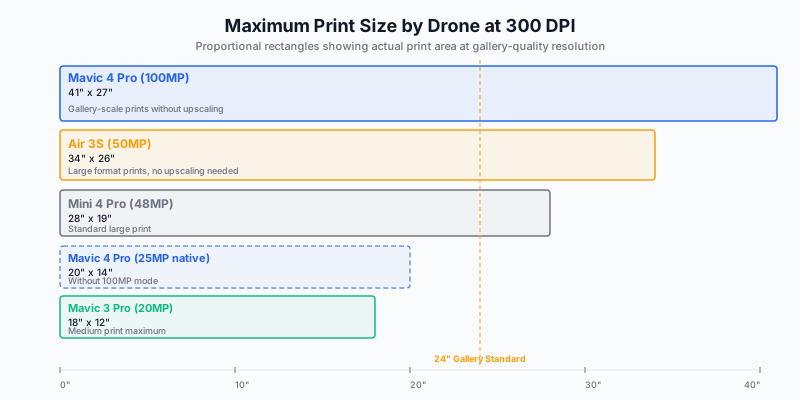
Print Size Reality Check
One of the most practical questions: how large can you print from each drone?
| Drone |
Native MP |
Max Print at 300 DPI |
Max Print at 200 DPI |
| Mavic 4 Pro (100MP mode) |
100 MP |
41” x 27” |
61” x 41” |
| Mavic 4 Pro (native) |
25 MP |
20” x 14” |
30” x 20” |
| Air 3S (wide) |
50 MP |
34” x 26” |
51” x 39” |
| Mini 4 Pro |
48 MP |
28” x 19” |
42” x 28” |
| Mavic 3 Pro (main) |
20 MP |
18” x 12” |
27” x 18” |
The Mavic 4 Pro’s 100MP mode produces files large enough for gallery-scale prints without upscaling. This is a first for consumer drones. The Air 3S’s 50MP output also prints remarkably large. For web and prints under 24 inches, all four drones produce files with resolution to spare.
Conclusion
The sensor is the drone. Everything else — the motors, the gimbal, the obstacle avoidance, the flight modes — exists to serve the sensor. When you evaluate drones for landscape photography, start with the sensor and work outward.
The Mavic 4 Pro sets a new standard with 14-bit RAW, 16-stop dynamic range, and a 100MP quad-Bayer mode that was unthinkable in a consumer drone two years ago. The Air 3S delivers a 1-inch sensor with 14-stop dynamic range at a mid-range price, making it the strongest value proposition in the current lineup. The Mavic 3 Pro remains capable but has been clearly superseded. The Mini 4 Pro’s sub-250g weight continues to provide regulatory freedom that no larger drone can match.
The gap between drone sensors and ground-based cameras narrows with every generation. The Mavic 4 Pro’s 16 stops of dynamic range and 14-bit DNG files would have been competitive with full-frame cameras five years ago. The aerial photographs that were once the exclusive domain of helicopter-mounted medium format cameras are now achievable with a device that fits in your backpack. Choose the drone that matches your quality requirements, your travel patterns, and your budget — then go make aerial photographs that justify the investment.