The Animal Does Not Care About Your Camera Settings
A cheetah accelerating to 110 km/h does not pause while you fumble with autofocus modes. A leopard dragging a kill into a tree does not wait for you to swap lenses. An elephant herd crossing a river at sunset gives you perhaps ninety seconds of peak light before the moment dissolves into memory.
Safari photography is the most demanding genre of wildlife work precisely because you cannot control the subject, the background, the light, or the timing. You can only control your preparation, your equipment choices, and how quickly you execute when opportunity arrives.
This guide covers the technical and strategic knowledge that separates photographers who return with snapshots from those who return with portfolio-defining images. It is built on field experience from the Masai Mara, Kruger, the Okavango Delta, and the Serengeti, and it assumes you are serious enough about your craft to invest in proper preparation.
Choosing Your Safari Destination
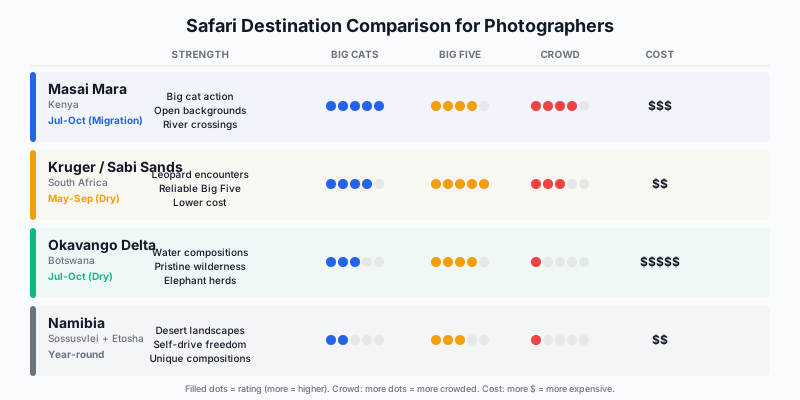
Not all African safaris are equal for photography. Each major destination offers different strengths, and your choice should align with your specific photographic goals.
Masai Mara, Kenya
Best period: July-October (Great Migration river crossings)
The Mara is the gold standard for big cat photography. The open grasslands provide clean backgrounds, the predator density is the highest in Africa, and the annual wildebeest migration delivers some of the most dramatic wildlife spectacles on the planet.
Why photographers choose the Mara:
- Greatest concentration of lions, cheetahs, and leopards on the continent
- Mara River crossings: wildebeest and zebra fording crocodile-infested waters
- Open terrain means cleaner backgrounds and fewer obstructed compositions
- Well-established photography-focused camps with guides who understand positioning
Limitations: Crowded during peak migration season. Multiple vehicles at popular sightings can create a circus atmosphere.
Kruger and Sabi Sands, South Africa
Best period: May-September (dry season, animals concentrate at water)
The most reliable destination for all Big Five species in a single trip. The Sabi Sands private reserve, adjoining Kruger, offers the best leopard viewing in Africa.
Why photographers choose Kruger/Sabi Sands:
- Most reliable Big Five destination
- Sabi Sands provides intimate leopard encounters at close range
- Self-drive option in Kruger for independent photographers
- Lower cost than East African destinations
- Southern light quality produces rich, warm tones
Limitations: Dense bush in many areas makes clean compositions harder. Self-drive means no expert guide positioning.
Okavango Delta, Botswana
Best period: July-October (dry season, water recedes and concentrates wildlife)
The Okavango offers a unique water-land interface that creates compositions impossible elsewhere. Elephants swimming through lily-pad-covered channels, hippos in crystalline water, and the drama of dry-season predation at water sources.
Why photographers choose Okavango:
- Unique aquatic wildlife compositions (mokoro canoe photography)
- Pristine, uncrowded wilderness
- Exceptional elephant herds
- Premium camps limit vehicle numbers at sightings
Limitations: Expensive. Among the most costly safari destinations in Africa. Limited self-drive access.
Namibia
Best period: Year-round (varies by region)
Namibia offers something no other African destination provides: the combination of wildlife and dramatic desert landscapes in the same trip. Desert-adapted elephants walking through sand dunes, Sossusvlei’s red sands at dawn, and Etosha’s waterhole dramas.
Why photographers choose Namibia:
- Desert-adapted wildlife in surreal landscapes
- Sossusvlei and Deadvlei offer world-class landscape subjects alongside wildlife
- Self-drive accessible throughout
- Etosha’s waterholes concentrate animals predictably
Limitations: Lower wildlife density than East Africa. Desert heat creates challenging mirage and haze conditions.
Camera Settings: The Foundation
Safari photography requires a different settings philosophy than landscape work. Speed and adaptability take priority over pixel-perfect optimization.
The Base Configuration
| Parameter |
Setting |
Rationale |
| Shooting mode |
Aperture Priority (A/Av) or Manual |
Control subject isolation |
| Aperture |
f/4 to f/5.6 |
Sharp subject, diffused background |
| ISO |
Auto, 100-6400 ceiling |
Adapts to rapidly changing light |
| Minimum shutter speed |
1/1000s |
Freezes most animal movement |
| AF mode |
Continuous (AF-C / AI Servo) |
Tracks moving subjects |
| AF area |
Dynamic area or wide tracking |
Allows subject movement within frame |
| Drive mode |
High-speed continuous |
Multiple frames per moment |
| Image quality |
RAW |
Maximum editing latitude |
This base configuration handles 80% of safari situations. Learn it until changing these settings is muscle memory, then adapt for specific scenarios.
Settings by Subject and Behavior
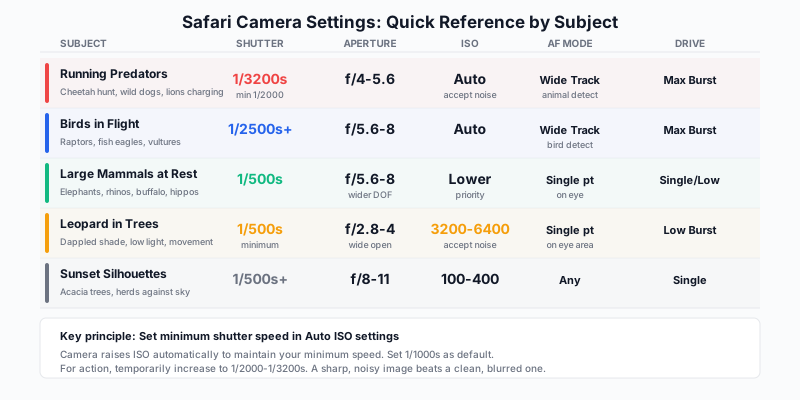
Running predators (cheetah, wild dogs, hunting lions)
| Parameter |
Setting |
| Shutter speed |
1/2000s minimum (1/3200s preferred) |
| Aperture |
f/4-f/5.6 |
| ISO |
Auto, accept noise for speed |
| Drive |
Maximum burst rate |
| AF |
Wide tracking with animal detection |
The cheetah hunt is the most technically demanding safari scenario. The animal accelerates explosively, changes direction unpredictably, and the critical moment, the takedown, lasts 2-3 seconds. Pre-focus on the predicted path and fire long bursts.
Birds in flight
| Parameter |
Setting |
| Shutter speed |
1/2500s or faster |
| Aperture |
f/5.6-f/8 |
| ISO |
Auto |
| AF |
Wide tracking, bird detection if available |
African raptors, particularly martial eagles, bateleurs, and fish eagles, provide dramatic in-flight subjects. Pre-focus on perched birds and track them as they take off. The launch moment often produces the strongest compositions.
Large mammals at rest (elephants, rhinos, buffalo)
| Parameter |
Setting |
| Shutter speed |
1/500s adequate |
| Aperture |
f/5.6-f/8 (wider DOF for groups) |
| ISO |
Lower priority, accept lower speed |
| Drive |
Single shot or low burst |
These subjects allow deliberate composition. Take the time to evaluate backgrounds, wait for head positions, and consider environmental context shots alongside tight portraits.
Leopard in trees (dappled light, movement)
| Parameter |
Setting |
| Shutter speed |
1/500s minimum |
| Aperture |
Wide open (f/2.8-f/4) |
| ISO |
Often 3200-6400 |
| AF |
Single point on eye area |
Leopard sightings typically occur in challenging light: dappled shade under tree canopy, early morning or late evening when the cat is active. High ISO is unavoidable. Accept the noise; a sharp, noisy image of a leopard is worth more than a clean, blurred one.
Lens Strategy
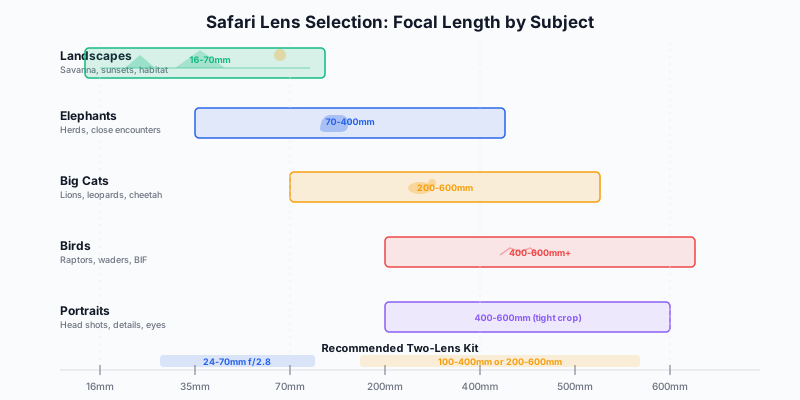
Lens selection determines what you can photograph on safari. Bring the wrong glass and you watch opportunities pass at the wrong focal length.
The Two-Lens Kit
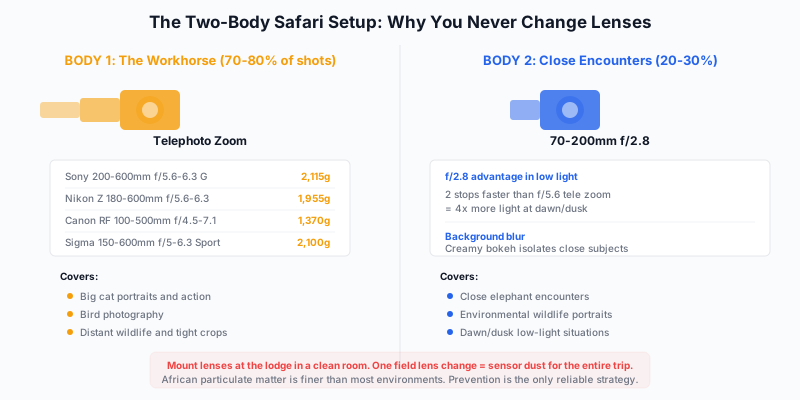
Professional safari photographers universally adopt a two-body, two-lens strategy:
Body 1: Telephoto zoom (the workhorse)
- Sony 200-600mm f/5.6-6.3 G OSS
- Canon RF 100-500mm f/4.5-7.1 L IS USM
- Nikon Z 180-600mm f/5.6-6.3 VR
- Sigma 150-600mm f/5-6.3 DG DN Sport
This lens lives on your primary body for 70-80% of the safari. It covers everything from mid-range animal portraits to tight headshots and distant action.
Body 2: Fast mid-range zoom (the closer encounters)
- 70-200mm f/2.8 (any major brand)
This lens handles close encounters, vehicle-to-vehicle shots, wider environmental compositions, and low-light situations where the f/2.8 aperture provides a critical advantage.
Why Two Bodies, Not Lens Changes
Dust. African safari environments produce fine particulate matter that will coat your sensor if you change lenses in the field. A single lens change on a dusty game drive can produce sensor spots that plague your images for the rest of the trip. Mount your lenses at the lodge, in a clean room, and do not remove them until you return.
Supplementary Lenses (If Weight Allows)
- 24-70mm f/2.8: Camp life, scenics, vehicle interior shots, wide-angle wildlife in context
- 1.4x teleconverter: Extends your telephoto reach at the cost of one stop of light
Telephoto Comparison for Safari
| Lens |
Reach |
Max Aperture at Long End |
Weight |
Street Price |
| Sony 200-600mm |
600mm |
f/6.3 |
2,115g |
$2,000 |
| Canon RF 100-500mm |
500mm |
f/7.1 |
1,370g |
$2,700 |
| Nikon Z 180-600mm |
600mm |
f/6.3 |
1,955g |
$1,700 |
| Sigma 150-600mm Sport |
600mm |
f/6.3 |
2,100g |
$1,500 |
| Tamron 150-500mm |
500mm |
f/6.7 |
1,725g |
$1,400 |
Support and Stabilization
Bean Bags (Essential)
The bean bag is the single most important support tool on safari. It rests on the vehicle door frame or window ledge, conforms to any surface, and provides remarkably stable support for heavy telephoto lenses.
Practical tips:
- Pack the bean bag empty. Fill with rice or dried beans purchased locally.
- A double-sided bean bag drapes over a car door and supports the lens on both sides.
- In open-top safari vehicles, the bean bag works on any rail or solid surface.
What Does Not Work in Vehicles
- Tripods: Impractical in vehicles. The legs interfere with other passengers and cannot be deployed quickly.
- Monopods: Marginally useful in open vehicles but inferior to bean bags.
- Gimbal heads: Only useful if the vehicle has a dedicated mounting clamp system.
Working with Guides
Your guide is the most important piece of equipment on safari. A skilled guide who understands photography priorities will position you for clean backgrounds, optimal light angles, and animal behavior you would never anticipate on your own.
Before the Drive
- State your priorities clearly: “I am focused on photography, not just viewing. I need time at sightings, good positioning, and I am happy to skip common species for better opportunities.”
- Discuss specific targets: “I want a strong lion portrait in golden light” is more useful than “I want to see lions.”
- Agree on communication: Establish hand signals for “move forward,” “stop here,” “kill the engine.”
During Sightings
Positioning is everything. A slight change in vehicle angle transforms a photograph from ordinary to compelling.
Priority 1: Light direction
- Side light (golden hours): Reveals texture, creates depth
- Front light: Even exposure, saturated color, lacks drama
- Backlight: Rim light on fur/mane, but challenging exposure
Priority 2: Eye level
- Getting low relative to the subject creates intimacy and power in the image
- In most safari vehicles, you are already above the animal. A bean bag on the door frame helps you shoot slightly downward rather than steeply
Priority 3: Background
- Clean grass or sky behind the subject, not other vehicles, tourists, or cluttered bush
- Ask the guide to reposition: “Can we circle around for a cleaner background?”
Priority 4: Space in the frame
- Leave compositional space in the direction the animal is looking or moving
- An animal walking toward the edge of the frame creates tension; walking into open space creates narrative
The Rhythm of a Safari Day
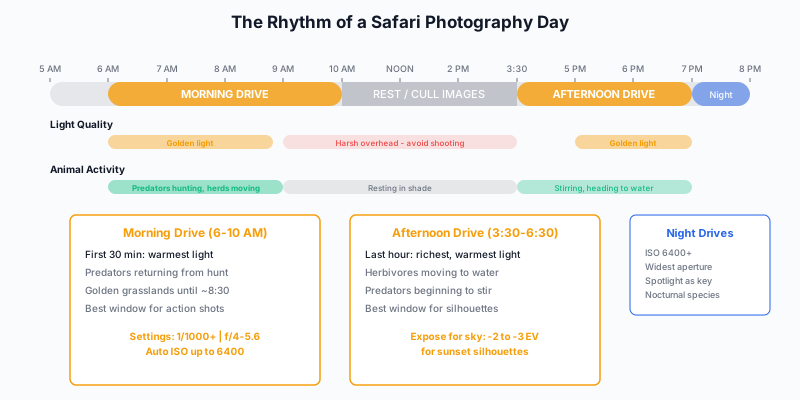
Morning Drive (6:00-10:00 AM)
- Depart at first light. The first 30 minutes produce the warmest, most directional light.
- Predators are most active in early morning, returning from overnight hunts or beginning new ones.
- Golden light on grasslands lasts until approximately 8:30 AM, depending on season and latitude.
- By 10:00 AM, harsh overhead light makes compelling wildlife photography difficult.
Midday (10:00 AM-3:30 PM)
- Return to camp for rest and image review.
- Process and cull images from the morning drive.
- Clean lenses and equipment.
- Predators are sleeping. Activity is minimal. Harsh light is unflattering.
Afternoon Drive (3:30-6:30 PM)
- Activity increases as heat drops. Herbivores move to water. Predators begin to stir.
- The last hour before sunset produces the richest light: warm, directional, dramatic.
- Sundowner stops (drinks at a scenic viewpoint) are traditional. Use this time for wide landscape compositions.
Night Drives (Where Permitted)
- Some reserves allow night drives with spotlights.
- Aardvarks, pangolins, honey badgers, and nocturnal predators become available.
- Settings: ISO 6400+, widest aperture, spotlight as key light. Challenging but rewarding.
Composition Beyond the Portrait
The instinct on safari is to fill the frame with the animal. Resist it, at least some of the time.
Environmental Wildlife Photography
A lion that fills 10% of the frame, dwarfed by an enormous African sky and stretching savanna, tells a more powerful story than a tight headshot. Steve McCurry’s approach to environmental portraiture applies directly to wildlife: the context reveals the character.
- Wide angle (24-70mm) with a distant subject
- Emphasis on habitat: the golden grass, the acacia silhouette, the storm clouds
- The animal as a punctuation mark in the landscape
Behavior Over Beauty
The images that endure are not the prettiest animal portraits. They are the moments of behavior: a mother grooming a cub, two bulls clashing horns, a bird landing on a hippo’s back, a predator’s focused stare before the charge.
- Anticipate behavior. Learn what precedes action. A lion that lowers its head and pins its ears is about to charge. A cheetah scanning the horizon is selecting prey.
- Fire before the peak moment. By the time you react to the action, it is often over. Start shooting when you sense the build-up.
Silhouettes
African sunsets against acacia trees produce some of the most recognizable images in wildlife photography. Underexpose by 2-3 stops relative to the sky, position the subject against the brightest part of the horizon, and let the shape tell the story.
Ethical Wildlife Photography
These are not guidelines. They are non-negotiable rules.
- Never bait, lure, or attract animals for a photograph. This includes playing recorded animal calls.
- Do not leave the vehicle except at designated points. You are a guest in predator territory.
- Respect distance limits. Your guide knows these. Do not pressure them to move closer.
- Do not chase animals for better positioning. Follow, observe, and wait.
- Kill the engine during sensitive moments: births, kills, mating, nursing. Engine vibration stresses animals.
- Limit time at sightings: If an animal shows stress signs (ears back, direct stare, mock charge, behavior change), leave immediately.
The welfare of the animal is more important than your photograph. Always.
Post-Safari Workflow
A 10-day safari generates 10,000-20,000 images. Without a culling strategy, you will drown in mediocrity.
The Three-Pass Cull
Pass 1: Technical rejection (30 minutes per day’s images)
Delete obvious failures: out of focus, severely over/underexposed, blocked compositions, closed eyes. Do not deliberate. If it is technically flawed, reject it.
Pass 2: Selection (1 hour per day’s images)
From each sequence, select the strongest 2-3 frames. Compare similar images using a lightbox view. Star or color-label your picks.
Pass 3: Final edit (cumulative)
Across the entire trip, identify your true portfolio images. For a 10-day safari, this should be 80-150 images worth full processing.
Processing Notes
- Safari images often need highlight recovery. Harsh African light clips highlights quickly.
- Eyes may need selective sharpening and brightening. The viewer’s attention follows the sharpest, brightest element.
- High-ISO noise reduction for dawn/dusk images. Modern AI denoise tools (Lightroom, Topaz) handle safari noise well.
- Straighten horizons. Shooting from a vehicle on uneven terrain produces consistent tilt.
What to Book
A photography-focused safari is not the same as a general wildlife safari. Key differences:
- Photography-specific camps limit vehicle occupancy (typically 2-4 photographers per vehicle instead of 6-8 tourists)
- Extended game drives: Photography camps stay out longer and return for peak light periods
- Guide quality: Photography guides understand positioning, light, and patience in ways that general guides may not
- Vehicle modifications: Bean bag rails, camera mounts, charging ports, and sometimes vehicle-mounted camera arms
Expect to pay 30-50% more for a photography-dedicated safari. The difference in image quality justifies every dollar.
The Patience Equation
Safari photography teaches a lesson that applies across every genre: the quality of your images is proportional to the time you spend waiting for the right moment, not the time you spend pressing the shutter.
The photographer who sits with a pride of lions for three hours, watching the light shift and the cubs play, will capture images that the photographer who drives up, fires thirty frames, and moves to the next sighting will never see.
Bring patience. Bring more patience than you think you need. Africa rewards those who wait.